
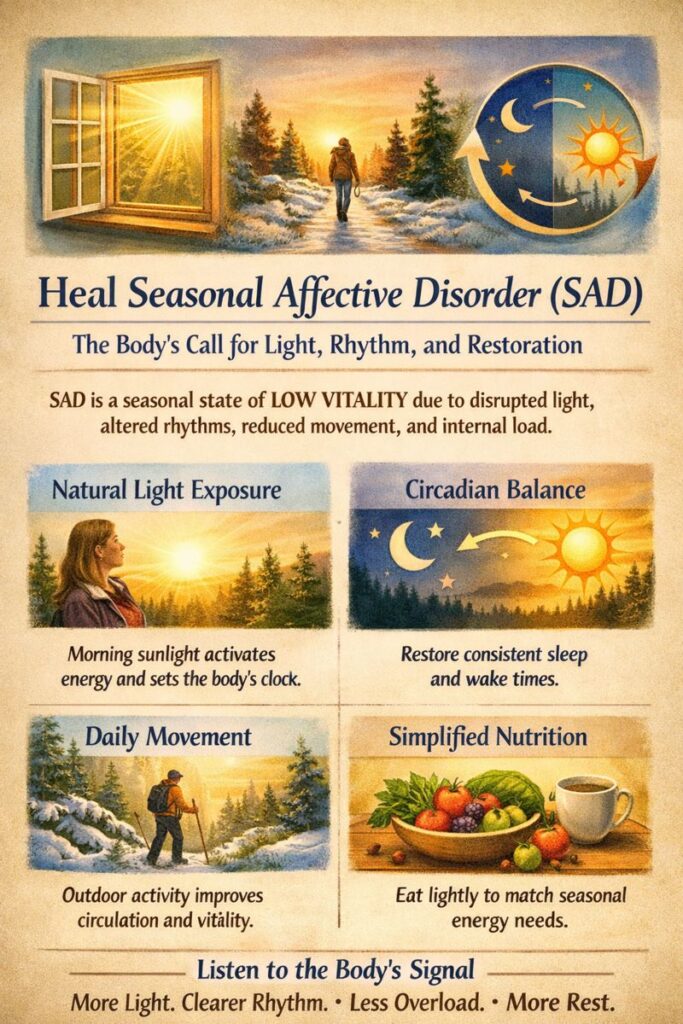
Seasonal Affective Disorder (SAD): A Natural Hygiene Perspective on Light, Rhythm and Seasonal Terrain
Seasonal Affective Disorder describes recurrent episodes of depression that follow a seasonal pattern, most commonly beginning during autumn or winter and improving during spring or summer. Changes in sleep, appetite, energy, concentration and motivation can accompany the low mood.
Natural Hygiene has a particularly strong contribution here because human physiology is profoundly rhythmic. Light, sleep timing, movement, food, activity and environment continually provide signals about time of day and season.
Light Is Biological Information
Light reaching the eyes influences the brain’s circadian clock. Morning and daytime light help coordinate sleep-wake timing, melatonin rhythms, alertness and many other daily physiological processes.
At higher latitudes, winter brings later sunrise, earlier sunset and much less intense daylight. Modern indoor living can reduce effective daytime light exposure still further. This gives the Natural Hygiene emphasis on living in relationship with natural light a strong physiological basis.
Circadian Rhythm and the Wider Terrain
The circadian system does not operate in isolation. Sleep timing, meals, physical activity and evening light exposure can all influence daily rhythms. Irregular late nights combined with weak morning light can make seasonal disruption more pronounced.
Natural Hygiene can therefore understand SAD partly as a mismatch between biological rhythms and the environment without claiming that every winter depression is simply the body choosing to conserve energy.
Is Winter Slowing Protective?
Humans often change behaviour with the seasons, and lower winter light can alter sleep and activity. Natural Hygiene may interpret some slowing as meaningful adaptation to changed environmental conditions.
The distinction is important: severe seasonal depression is not proven to be a deliberately manufactured conservation programme. A response can be influenced by the environment without every consequence of that response being beneficial.
Vital Economy and Enervation
Winter can create an interesting Vital Economy problem. Some people receive less daylight and movement while work, digital stimulation and social demands remain unchanged. Sleep may become later or less refreshing while the person continues trying to produce summer-like levels of output.
Natural Hygiene’s concept of enervation asks whether demand is being matched by recovery. Respecting a genuine need for rest can help, but prolonged withdrawal and inactivity can also deepen the loss of light, movement and social rhythm.
Movement and Outdoor Light
Going outdoors during daylight combines two useful inputs: physical activity and substantially brighter light than most indoor environments. Even cloudy outdoor light can be much brighter than ordinary room lighting.
This does not “move lymphatic toxins causing depression”; it strengthens daytime signals to the circadian system while supporting movement, sleep and general health.
Food and Seasonal Cravings
Some people with winter-pattern SAD experience increased appetite and carbohydrate cravings. Sleep, circadian timing, mood and reward systems can all influence eating behaviour.
Natural Hygiene favours simple whole foods, fresh fruit and vegetables and avoiding dependence on stimulants for artificial alertness. But cravings should not automatically be interpreted as accumulated toxins or proof that the body needs a cleanse.
Bright Light and Natural Light
Morning outdoor light is a useful natural rhythm cue. For people with significant winter-pattern SAD, appropriately timed bright-light therapy can also influence the circadian system and mood. Its effect is biological rather than merely psychological.
The Emotional Signal
Natural Hygiene is right to resist treating every difficult feeling as meaningless malfunction. Mood can contain information about sleep, environment, isolation, workload, relationships and the conditions in which someone is living.
But depression can also become severely impairing. The fact that a symptom contains information does not mean it should always be left alone or interpreted as healing.
The Observation and the Interpretation
The observation is that seasonal light exposure can alter circadian timing, sleep, energy and mood. Natural Hygiene interprets this within the wider terrain of light, movement, rest, nourishment and environmental rhythm.
What goes beyond the evidence is claiming that SAD is fundamentally toxic stagnation or that winter depression is always a purposeful conservation mechanism.
The Natural Hygiene Interpretation
SAD illustrates something central to Natural Hygiene: health depends partly on whether the environment provides the biological conditions to which the organism is trying to respond.
Light, rhythm, movement, sleep, nourishment, connection and appropriate rest are therefore not peripheral lifestyle details. They are part of the terrain in which nervous-system and endocrine regulation take place.
Related Nervous-System and Rhythm Reading
Natural Hygiene foundation: Vital Economy, rest and nervous-system recovery