
Natural Hygiene: Why Your Body Isn’t Simply Breaking Down
Natural Hygiene, sometimes called Natural Internal Hygiene, is a health philosophy built around a powerful observation: the human body is continuously regulating, repairing, recycling and adapting itself. Health is therefore influenced not only by what is done to the body, but by the conditions in which those biological processes must operate.
Classical Natural Hygiene developed through figures including Isaac Jennings, Sylvester Graham, Herbert Shelton, John Tilden and T.C. Fry. Natural Body Intelligence carries many of those principles forward while also considering modern knowledge about physiology, sleep, stress, metabolism, circadian rhythms, cellular recycling and the nervous system.
The Core Principle: The Body Is Self-Regulating and Self-Repairing
Wounds close. Bone remodels. Liver tissue can regenerate to a remarkable degree. Cells repair DNA and proteins. Autophagy recycles cellular components. Apoptosis dismantles unwanted cells. Macrophages clear damaged material. Kidneys regulate fluid and electrolytes. Hormonal feedback systems continually adjust internal conditions.
These are not philosophical ideas; they are observable biology. Natural Hygiene begins with those capacities and asks: what conditions support them, and what conditions repeatedly interfere with them?
Self-healing does not mean unlimited healing. Some damage is irreversible, genetic conditions exist, tissues differ greatly in regenerative capacity and serious disease can overwhelm the body’s ability to compensate. The Natural Hygiene principle is that inherent repair should be supported, not that biology has no limits.
Toxaemia: The Classical Natural Hygiene Model
Classical Natural Hygiene teaches that disease develops on a background of enervation and toxaemia: demands exceed recovery, elimination becomes less efficient and the internal terrain becomes increasingly unfavourable.
There is substantial observable physiology beneath this idea. Cells continually produce metabolic by-products. The liver transforms substances. Kidneys filter and excrete material. The lungs remove carbon dioxide and volatile compounds. The bowel eliminates material. Lymphatic vessels transport excess interstitial fluid, proteins and cellular material. Environmental substances can enter the body and some can accumulate in tissues.
Natural Hygiene brings these processes together under the broader concept of toxaemia. Conventional medicine does not recognise one universal state of systemic toxaemia as the cause of all disease, and different diseases have different established mechanisms. NBI therefore uses toxaemia as a terrain model: a way of asking whether production and exposure, processing, repair and elimination are remaining in balance.
Disease: Response, Damage or Both?
Classical Natural Hygiene often says that “disease is the body’s attempt to restore health”. That statement becomes more useful when we separate the response from the underlying damage.
Fever is regulated. Inflammation recruits cells and changes blood flow. Coughing moves material from airways. Vomiting can rapidly expel stomach contents. Pain can protect an injured area. Fatigue can reduce activity. These responses can have clear biological purposes.
But the condition provoking the response may still damage tissue, and the response itself can sometimes become excessive or harmful. Natural Hygiene’s contribution is to ask what a symptom is doing before automatically trying to silence it. That does not require treating every symptom as harmless or every disease process as beneficial.
Terrain: Conditions Matter
The same exposure or challenge does not produce an identical outcome in every person. Age, sleep, nutrition, metabolic health, genetics, previous tissue damage, stress, smoking, alcohol, medications and many other factors influence susceptibility and recovery.
Microorganisms also respond to their environment. Nutrients, oxygen, acidity, moisture, competing organisms and host tissues influence where and how they proliferate. Natural Hygiene calls this wider biological context the terrain. Terrain does not mean triggers are irrelevant; it means a trigger always encounters a particular living environment.
The Laws of Life
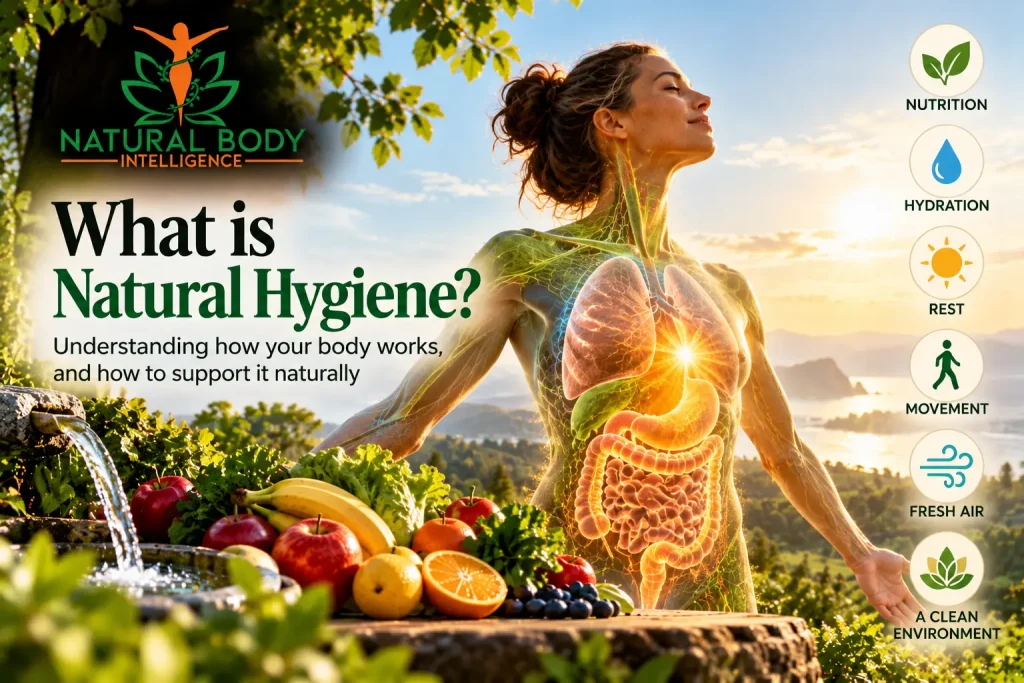
Natural Hygiene traditionally emphasises fresh air, water, sunlight, sleep and rest, nourishing food, movement, emotional balance and a supportive environment. NBI extends this to include circadian rhythm, nervous-system load, relationships, overstimulation, purpose and the pace of modern life.
These are not magical cures. They are conditions that influence measurable physiology: sleep affects hormones and nervous-system function; daylight helps entrain circadian rhythms; movement changes cardiovascular and musculoskeletal function; nutrition supplies substrates required for metabolism and repair.
Rest, Fasting and Vital Economy
Natural Hygiene places unusual emphasis on reducing demands rather than continually adding treatments. The Law of Vital Economy describes the body’s continual prioritisation of available resources.
During fasting, insulin falls, stored fuels are mobilised, ketone production rises and nutrient-sensing pathways change. Cellular recycling mechanisms such as autophagy provide a modern biological connection with the older Natural Hygiene concept of autolysis. Fasting is therefore a profound change of physiological state, although it is not a universal treatment and longer fasting is not automatically better.
Food and the Internal Environment
Natural Hygiene traditionally favours simple, minimally processed, water-rich plant foods, with fruit occupying a particularly important place. Whole fruits provide carbohydrate, water, potassium, vitamins, phytochemicals and fibre.
Their high water content contributes meaningfully to hydration. Adequate fluid supports plasma volume, circulation, kidney filtration and urinary excretion. This gives the Natural Hygiene emphasis on water-rich food a straightforward physiological basis without needing to claim that fruit contains a special form of water unavailable from ordinary drinking water.
Symptoms: The Body’s Language
NBI treats symptoms as information. A symptom tells us that something is happening; the next question is what?
Some symptoms are protective responses. Some reflect adaptation. Some arise from tissue damage or loss of function. Some contain elements of all three. The Natural Hygiene approach is strongest when it investigates that meaning rather than assuming either that every symptom is a malfunction or that every symptom is detoxification.
Natural Hygiene in the Twenty-First Century
Natural Body Intelligence does not need to abandon the central ideas of Natural Hygiene in order to examine them more carefully. In many cases modern physiology gives us better language for observations Hygienists were already trying to describe: adaptation, feedback regulation, cellular recycling, tissue remodelling, metabolic switching, circadian biology, stress physiology and the influence of the surrounding terrain.
The central question remains remarkably simple: instead of asking only what we can add to suppress a symptom, what conditions does the body require to regulate, repair and function as well as it is capable of doing?
Continue Exploring Natural Hygiene
- Natural Hygiene Dictionary
- Vital Economy
- Toxaemia
- Rest & Fasting
- Seven Stages of Disease
- The Body’s Systems
- Understanding Symptoms