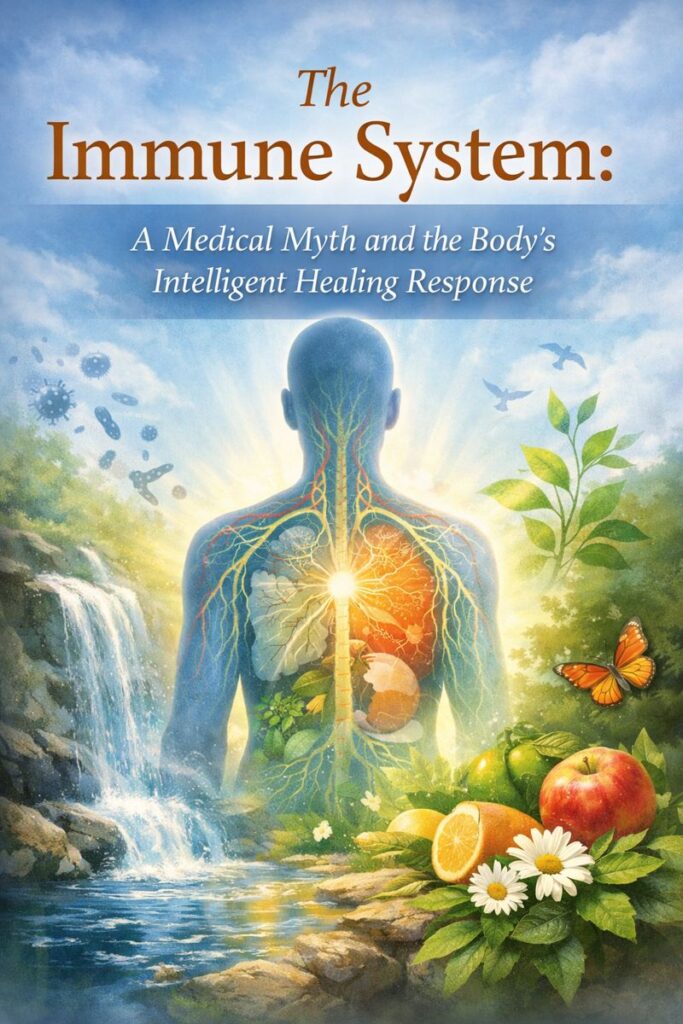
The Immune System: A Medical Myth and the Body’s Intelligent Healing Response
Modern health education teaches that the human body is under constant attack. According to this view, bacteria, viruses, allergens, and even the body’s own tissues threaten survival, and health depends on the strength of an internal defence force known as the immune system.
This story is familiar, reassuring in its simplicity, and deeply ingrained. Yet it does not accurately describe how the body maintains health or how healing truly occurs.
From a Natural Hygiene perspective, the body does not survive by fighting itself or the world around it. Health is preserved through clean internal conditions, adequate vitality, and unobstructed elimination. What is commonly described as “immune activity” is better understood as the body’s intelligent healing response to internal overload, irritation, and fatigue.
How the Immune System Narrative Took Hold
The immune system model developed alongside germ theory in the late nineteenth century. As microbes were identified, disease was increasingly blamed on external organisms rather than internal conditions. Illness became a battle, and the body a battlefield.
This framework made illness easier to categorise and easier to treat mechanically. If germs cause disease, then killing germs must restore health. If inflammation is dangerous, then suppressing it must be beneficial.
Yet this narrative creates contradictions that are rarely addressed:
-
Microbes are present in healthy and sick people alike
-
The same exposure produces vastly different outcomes
-
Symptoms often worsen when they are suppressed
-
The body frequently heals without intervention
These inconsistencies point to a deeper truth: disease does not begin with invasion, but with internal imbalance.
What Actually Happens When the Body Becomes Ill
The human body is constantly producing waste as a result of metabolism. Under ideal conditions, this waste is eliminated efficiently through the bowels, kidneys, lungs, and skin.
When elimination is impaired by:
-
improper food,
-
overeating,
-
stimulants,
-
emotional stress,
-
lack of rest,
-
or environmental toxins,
waste begins to accumulate faster than it can be removed.
At this point, the body initiates protective and corrective responses. These responses are what we recognise as symptoms.
Inflammation, fever, swelling, pain, fatigue, mucus production, and discharge are not signs of failure. They are signs of intelligence. The body is attempting to dilute, mobilise, neutralise, and expel toxic material while protecting vital tissues.
There is no separate system making strategic decisions. The body functions as one integrated organism responding to conditions it finds itself in.
Inflammation as a Healing Process
Inflammation is often portrayed as dangerous or destructive, yet it is one of the body’s most important restorative tools.
When tissues are irritated by acidic waste or chemical residues, circulation is increased to the area. Blood brings oxygen, fluids, and nutrients that help dissolve waste and repair damage. Heat and swelling are part of this process, not mistakes within it.
Suppressing inflammation may temporarily reduce discomfort, but it does not remove the cause. In many cases, it forces waste deeper into tissues, setting the stage for chronic conditions and degeneration.
Inflammation is the body asking for:
-
rest,
-
reduced intake,
-
improved elimination,
-
and conservation of energy.
Listening to that request is far more effective than silencing it.
Fever: Nature’s Accelerated Cleanse
Fever is one of the most misunderstood healing responses.
A raised temperature increases metabolic activity and accelerates the breakdown of toxic residues. Appetite naturally diminishes, encouraging fasting so that energy can be redirected from digestion to repair.
Children experience fevers frequently because their bodies are growing rapidly and eliminating waste at the same time. Suppressing fevers interrupts this process and often leads to recurring issues later in life.
Fever is not an enemy. It is a controlled, purposeful increase in internal activity designed to restore balance.
The Myth of the Body Attacking Itself
One of the most damaging consequences of the immune system narrative is the idea of “autoimmune disease”, the belief that the body inexplicably turns against itself.
From a biological standpoint, this makes little sense. The body does not suddenly lose the ability to recognise its own tissues. What is labelled as autoimmune disease is more accurately described as chronic inflammation and tissue breakdown resulting from prolonged toxicity and irritation.
Different tissues are affected depending on:
-
inherited resilience,
-
weakest elimination pathways,
-
previous injuries,
-
emotional strain,
-
and overall vitality.
The symptoms are real. The explanation is flawed.
When internal conditions improve and energy is restored, many of these conditions stabilise or reverse without the need to suppress the body’s responses.
Microbes as Scavengers, Not Invaders
Bacteria, fungi, and viruses are commonly blamed for illness, yet they appear wherever decomposition is present. Their role is not to cause disease, but to assist in breaking down waste when normal elimination is insufficient.
In clean internal conditions, microbial populations remain balanced. When waste accumulates, scavengers proliferate.
Attempting to destroy microbes without addressing the internal environment is like spraying flies while ignoring the rubbish. Once the terrain is cleaned, microbial balance restores itself naturally.
The Body’s True Healing Intelligence
Rather than an immune system, Natural Hygiene recognises the body’s integrated healing intelligence, expressed through:
-
circulation and blood flow,
-
lymphatic drainage,
-
nervous system regulation,
-
cellular detoxification,
-
emotional discharge,
-
and energy conservation.
Healing occurs when the body is allowed to redirect energy away from digestion and stress and towards repair and elimination. This is why rest, fasting, sleep, fresh air, and simple foods have been central to healing traditions across cultures.
The body does not need to be stimulated to heal. It needs to be unburdened.
Why Suppression Leads to Chronic Illness
When symptoms are consistently suppressed rather than understood, the body adapts by pushing waste deeper.
What begins as:
-
colds,
-
rashes,
-
digestive upsets,
-
fevers,
can progress into:
-
chronic inflammation,
-
hormonal disruption,
-
nervous exhaustion,
-
degenerative disease,
-
and late-stage pathology.
This progression is not inevitable. It is the result of interrupted healing.
By removing the causes that make symptoms necessary, the body no longer needs to express them.
Rethinking Health and Disease
Illness is not the body failing. It is the body communicating.
Symptoms are messages about internal conditions that require attention, not enemies to be destroyed. When the body is supported through rest, simplicity, hydration, and clean nutrition, healing becomes more efficient and less frightening.
The immune system narrative teaches fear and dependence. Understanding the body’s intelligent healing responses restores trust and responsibility.
In Summary
-
The body does not attack itself
-
Symptoms are purposeful responses, not malfunctions
-
Germs do not cause disease; internal conditions do
-
Healing depends on elimination, rest, and vitality
-
Suppression delays recovery and deepens imbalance
When we stop trying to control the body and start cooperating with it, health becomes the natural outcome once again.