
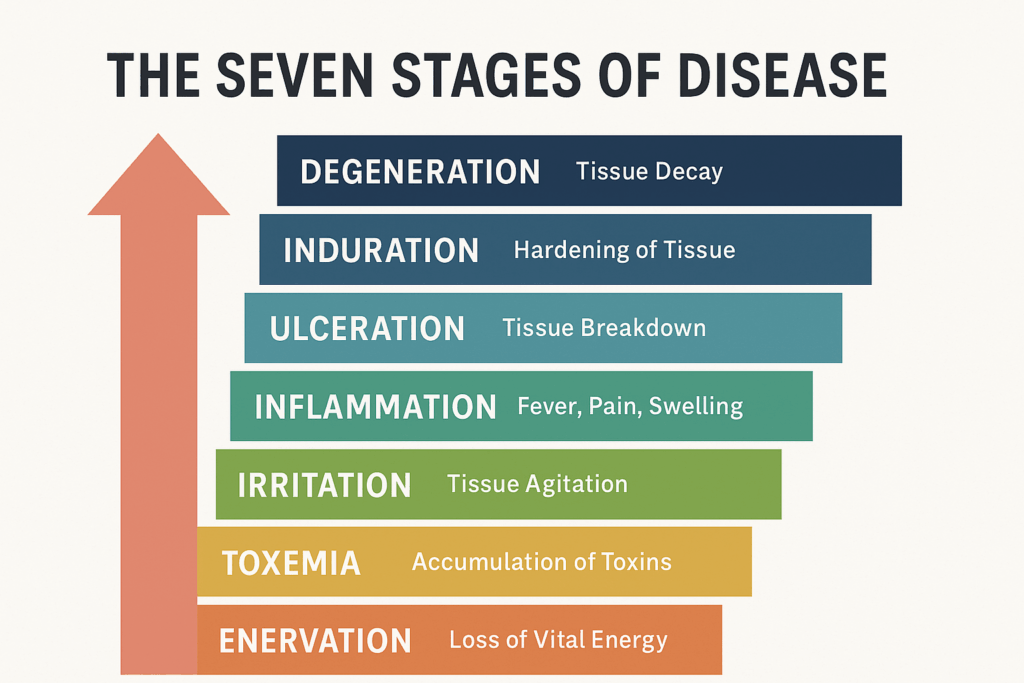
The Seven Stages of Disease: A Natural Hygiene Framework
The Seven Stages of Disease is a traditional Natural Hygiene model describing a proposed progression from declining vitality and impaired elimination towards increasingly serious tissue change. It is not the classification system used in conventional pathology. Its value within Natural Hygiene is as a framework for thinking about terrain, adaptation, elimination and the consequences of repeatedly living beyond the body’s capacity to recover.
The stages are: enervation, toxaemia, irritation, inflammation, ulceration, induration and degeneration. Some parts correspond readily with measurable physiology; others represent a broader Natural Hygiene interpretation of what those observations mean.
Watch: The Seven Stages of Disease
Stage 1 – Enervation: Demand Exceeds Recovery
Natural Hygiene uses enervation to describe a state in which repeated physical, mental, digestive or emotional demands are not being matched by sufficient recovery. Modern physiology does not measure a single reservoir of “nerve energy”, but sleep debt, overtraining, prolonged stress, inadequate nutrition and illness can all reduce performance and recovery.
This is closely related to the Law of Vital Economy: the body continually prioritises resources according to circumstances. Fatigue can therefore be useful information rather than merely an inconvenience to override with stimulation.
Stage 2 – Toxaemia: The Internal Burden
Natural Hygiene uses toxaemia more broadly than conventional toxicology. It refers to the total burden created when metabolic products, environmental exposures and lifestyle demands are considered alongside the body’s ability to process, transport and eliminate material.
Physiologically, cells continually produce metabolic by-products; the liver transforms many substances; the kidneys filter and excrete material; the lungs remove carbon dioxide and volatile compounds; the bowel removes material; lymph transports interstitial fluid and proteins. These processes are measurable. What is not established is a single general “toxin level” that explains every chronic disease. Toxaemia is therefore the Natural Hygiene interpretation of the wider terrain rather than one laboratory diagnosis.
Stage 3 – Irritation: Early Disturbance
Irritation describes altered sensation or tissue response before major structural damage is apparent. Itching, burning, sensitivity, coughing or digestive discomfort can arise when sensory nerves and tissues respond to chemical, mechanical, inflammatory or environmental stimuli.
Natural Hygiene interprets recurring irritation as an early message to examine the conditions surrounding the tissue. That is useful as a general principle, although irritation does not inevitably progress through the remaining six stages.
Stage 4 – Inflammation: Organised Biological Response
Inflammation involves coordinated changes in blood vessels, signalling molecules, fluid movement and cellular activity. Redness, warmth, swelling and pain can therefore have understandable biological functions.
This supports the Natural Hygiene observation that inflammation is not meaningless malfunction. However, inflammation is not simply stored waste being dissolved and removed. Persistent or excessive inflammation can itself damage tissue. Treatment that reduces harmful inflammation does not demonstrate that toxins have been driven deeper into the body.
Stage 5 – Ulceration: Tissue Breakdown
An ulcer is an area where surface tissue has been lost. Ulceration can occur through inflammation, impaired blood supply, pressure, chemical injury and other mechanisms.
Natural Hygiene historically interpreted ulceration as an intensified attempt to remove irritating material. The observable fact is that damaged tissue is breaking down and material can leave the surface. What has not been established is that the body deliberately destroys healthy tissue to manufacture a new detoxification channel. Ulceration can be serious and sometimes requires urgent treatment.
Stage 6 – Induration: Hardening, Fibrosis and Containment
Induration means abnormal hardening of tissue. Fibrosis and scar formation are genuine biological processes in which connective tissue is deposited during repair or persistent injury. Encapsulation can also occur around some foreign material or abnormal structures.
This provides an observable basis for the Natural Hygiene idea of “walling off”. But cysts, fibroids, tumours, warts and cirrhosis do not all arise through one mechanism and should not all be described as packages of stored toxins. Different tissues undergo different pathological processes.
Stage 7 – Degeneration: When Damage Outpaces Repair
Tissues are continually maintained and renewed, but their capacity for repair is not unlimited. Age, genetics, repeated injury, metabolic conditions, vascular damage, environmental exposures and many other factors can contribute to progressive loss of structure or function.
Natural Hygiene describes this end of the spectrum as degeneration: conditions have remained unfavourable long enough that breakdown exceeds successful repair. The practical message is to improve modifiable conditions wherever possible. It should not be interpreted as a promise that advanced cancer, organ failure or severe structural degeneration can always be reversed through fasting or lifestyle change.
Does Healing Happen in Reverse?
Natural Hygiene often describes recovery as healing in reverse: as the terrain improves, a person may move from chronic dysfunction towards more normal regulation and may temporarily experience changing symptoms along the way.
There are real examples of biological reversibility. Fat stored in the liver can decrease, insulin sensitivity can improve, tissues remodel after injury and inflammatory activity can settle when its drivers change. Other changes — such as extensive scarring, destroyed nerve cells or advanced structural damage — may be only partly reversible or irreversible.
So “healing in reverse” is best understood as a Natural Hygiene principle of recovery rather than a rule that every disease retraces seven stages in exact reverse order.
Healing Crisis: Observation and Interpretation
People sometimes experience headaches, fatigue, digestive changes, altered bowel habits, skin changes or other symptoms after major changes in diet, stimulant use or fasting. Natural Hygiene traditionally calls some of these experiences a healing crisis and interprets them as part of adaptation and increased elimination.
Some mechanisms are straightforward: caffeine withdrawal can cause headache and fatigue; fasting changes fuel metabolism and can alter fluid and electrolyte balance; dietary changes alter bowel contents and fermentation. These observations do not prove that every new or worsening symptom represents toxins leaving the body.
The useful distinction is the same throughout Natural Hygiene: observe what the body is doing, consider why it may be happening, but do not use the healing-crisis label to dismiss a potentially serious symptom.
What the Seven Stages Are Really Asking
The lasting value of the Seven Stages model is the question underneath it: what conditions have brought the body to its present state, and which of those conditions can be changed?
Rest, sleep, appropriate nourishment, hydration, movement, sunlight, reduced exposure to harmful substances and periods of physiological rest can all change the terrain. Natural Hygiene places the emphasis on removing unnecessary causes and supporting the body’s inherent capacity for regulation and repair, while recognising that different diseases have different mechanisms and different limits to reversibility.