Natural Hygiene has a language of its own.
Some of its most interesting ideas are hidden behind words that have almost disappeared from modern health discussion: Biogony, Orthobionomics, Bionomy, Orthotrophy, Orthokinesiology, Orthopathy, Enervation and others.
Herbert M. Shelton used this vocabulary because he believed conventional health language often failed to distinguish between very different biological processes.
These terms were part of a much bigger attempt to understand a simple question:
What happens when we study the body first as a living organism rather than merely as a collection of diseases?
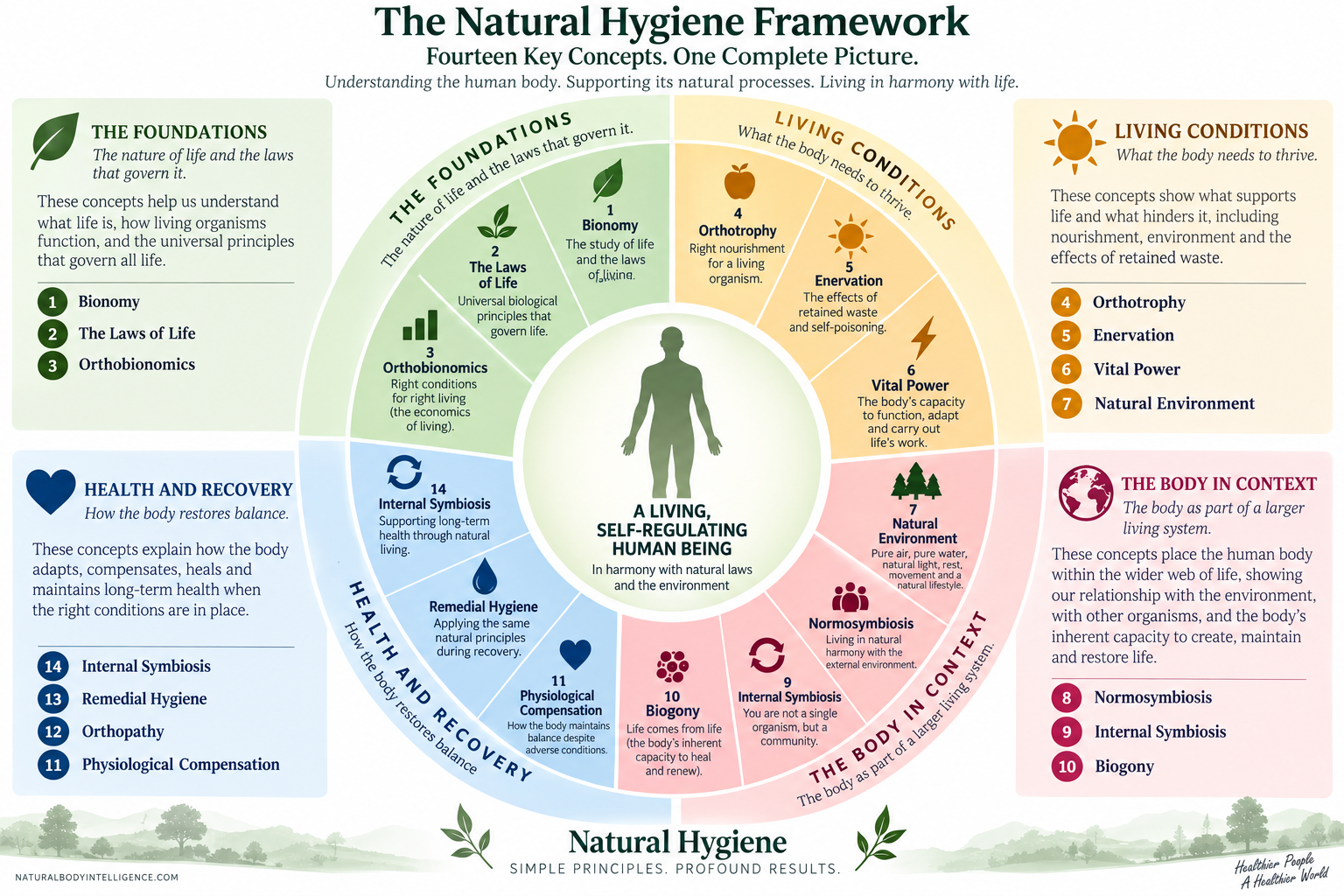
This guide brings together 14 of these largely forgotten Natural Hygiene ideas and shows how they connect.
Watch: Life Science Philosophy
This Natural Body Intelligence video provides a useful introduction to the wider Life Science philosophy behind Natural Hygiene, giving context to the historical terms and biological principles explored throughout this guide.
Why did Natural Hygiene need its own vocabulary?
The early Hygienists were interested in life, biological needs, adaptation, environment, cause and effect, functional capacity and recovery.
Shelton believed existing terminology sometimes obscured important distinctions. Most famously, he objected to using the single word disease for both active physiological responses and structural degeneration.
So he and other writers used specialised terms to describe the relationships they believed existed between life, health and disease.
Some terms were inherited from earlier writers. Some were adapted. Some Shelton explicitly said he coined himself.
Together they reveal Natural Hygiene as a much broader philosophy than simply a diet or fasting method.
1. Biogony — the struggle of life
Biogony may be one of Shelton’s most fascinating forgotten words.
He used it for active physiological processes that he regarded as defensive, adaptive or restorative, distinguishing them from damaged or degenerated tissue.
The distinction matters because a symptom is an activity or experience, whereas pathology can involve structural deterioration.
Read: Biogony — Herbert Shelton’s Forgotten Word for the Body’s Struggle to Restore Health
2. Orthobionomics — adapting life and environment
Shelton said he coined Orthobionomics to describe the correct adaptation of environment to life.
Rather than continually forcing the organism to adapt to unsuitable circumstances, Orthobionomics asks whether our conditions of living actually match our biological requirements.
That includes far more than food: sleep, light, movement, rest, air, water, temperature, stimulation and other environmental influences all belong to the picture.
Read: Orthobionomics — Herbert Shelton’s Forgotten Science of Living in Harmony with Life
3. Bionomy — the laws of living functions
Bionomy was not invented by Shelton. The word had appeared in earlier biological and health writing.
Shelton described it as the science of the laws of living functions and a branch of biology concerned with habits and adaptation.
Bionomy gives us the foundation beneath much of Natural Hygiene: understand what living organisms require because of the kind of organisms they are.
Read: Bionomy — The Forgotten Science of the Laws of Life
4. Orthotrophy — correct feeding
Shelton said he coined Orthotrophy for the part of Orthobionomics dealing with food and feeding.
The concept moves nutrition beyond isolated nutrients and asks about the entire biological process of eating: what we eat, how the body digests it, when we eat and the conditions under which food is used.
Natural Hygiene traditionally placed particular emphasis on fresh fruits and simple plant foods suited to human digestion.
Read: Orthotrophy — Herbert Shelton’s Forgotten Science of Correct Nutrition
5. Orthokinesiology — correct movement
Natural Hygiene was never intended to stop at diet.
Orthokinesiology was Shelton’s exercise and movement branch of the Hygienic System.
He explored movement, posture, strength, endurance, exercise versus work and the physiological effects of physical activity.
The underlying principle remains useful: appropriate movement develops capacity, while excessive demand without recovery can deplete it.
Read: Orthokinesiology — Herbert Shelton’s Forgotten Science of Correct Movement
6. Orthogenetics — reproduction, children and parenthood
Orthogenetics was the fifth volume of Shelton’s Hygienic System.
His historical framework covered reproduction, birth, parenthood, children, relationships and sexual function.
The terminology predates modern molecular genetics and should not be confused with contemporary genomics. Its importance to the Hygienic System is that Shelton extended the conditions-of-life principle across the entire human life cycle.
Read: Orthogenetics — Herbert Shelton’s Forgotten Natural Hygiene of Reproduction and Parenthood
7. Orthopathy — understanding disease differently
Orthopathy sits at the centre of Shelton’s interpretation of illness and recovery.
It asks us to distinguish between what the organism is actively doing and the pathological condition of damaged tissue.
This is closely connected with Biogony and with Shelton’s argument that the word disease can sometimes conceal important biological differences.
Read: Orthopathy — Herbert Shelton’s Forgotten Way of Understanding Disease and Recovery
8. Enervation — reduced functional capacity
Enervation predates Shelton and was especially associated with John H. Tilden’s theory of toxaemia.
Natural Hygienists used it to describe a reduction in available functional capacity associated with excessive demands and inadequate recovery.
Overwork, inadequate sleep, excessive exertion, emotional strain and continual stimulation were among the conditions discussed in relation to enervation.
Read: Enervation — The Forgotten Natural Hygiene Explanation for Why the Body Loses Functional Power
9. Physiological Compensation — how the body adapts
The body can function under conditions that are far from ideal because it is extraordinarily adaptable.
Physiological compensation describes the adjustments that help maintain important functions when circumstances change.
This ability can also hide the cost of unsuitable conditions. Being able to tolerate something does not necessarily mean that it is biologically ideal.
Read: Physiological Compensation — What Does the Body Sacrifice When Resources Are Limited?
10. Normosymbiosis — living in relationship with other life
Human beings do not exist in biological isolation.
Shelton used NormSymbiosis in his wider discussion of the normal relationships between living organisms and their environment.
Modern biology has since revealed extraordinarily complex ecological relationships between humans, microbes and the wider natural world, although Shelton’s historical framework should not be confused with modern microbiome science.
Read: Normosymbiosis — Herbert Shelton’s Forgotten Idea of Normal Cooperation Between Living Things
11. Internal Symbiosis — the body as habitat
The skin, mouth and digestive tract are not biologically empty spaces.
They provide habitats for vast microbial communities.
Internal Symbiosis provides an historical doorway into thinking about the body as an ecosystem — an idea made far richer by modern microbiome research.
Read: Internal Symbiosis — You Are Not a Single Organism
12. Remedial Hygiene — the conditions of health during recovery
What does a sick body require?
Natural Hygiene begins with an unusual answer: it remains a living human organism with the same fundamental biological requirements, although how those requirements are appropriately supplied may change according to circumstances.
Remedial Hygiene applies the conditions of healthy living to periods of illness and recovery rather than treating health as something that must be manufactured externally.
Read: Remedial Hygiene — Why the Conditions That Maintain Health Also Matter During Recovery
13. The Laws of Life — biological principles before health practices
Why sleep? Why movement? Why rest? Why appropriate food?
Natural Hygiene’s answer is that these practices matter because they follow from the biological requirements of a living organism.
The Laws of Life were an attempt to put principles before remedies: understand the organism, its needs, its environment and the consequences of violating those needs.
Read: The Laws of Life — What Did the Early Natural Hygienists Mean?
14. Vital Power — the body’s capacity to perform biological work
Terms such as vital force and vital power can sound mystical today.
Read historically, however, they can be understood more usefully as attempts to describe the living organism’s changing capacity to function, adapt and carry out biological work.
This connects directly with Enervation, rest, stimulation, recovery and Physiological Compensation.
Read: Vital Power — What Did Natural Hygienists Mean by the Body’s “Vital Force”?
How these ideas fit together
These terms are easiest to understand as parts of one system rather than fourteen unrelated definitions.
Bionomy asks about the laws and adaptations of living organisms.
Orthobionomics asks how the environment can be matched to those biological requirements.
Orthotrophy applies that thinking to food. Orthokinesiology applies it to movement. Orthogenetics extended Shelton’s framework into reproduction and parenthood.
Enervation and Vital Power concern functional capacity and demand, while Physiological Compensation explains how the organism adapts when conditions are imperfect.
Normosymbiosis and Internal Symbiosis place the organism within networks of other living things.
Biogony and Orthopathy concern Shelton’s interpretation of active physiological responses and pathology.
Remedial Hygiene asks how the requirements of life apply during recovery.
And the Laws of Life provide the broad philosophical foundation beneath them all.
Natural Hygiene is bigger than diet
Perhaps the most important lesson from rediscovering this vocabulary is how broad Natural Hygiene originally was.
It included food, but it was not simply a diet.
It included fasting, but it was not simply a fasting system.
It considered exercise, rest, sleep, environment, reproduction, adaptation, physiological capacity, recovery and the relationships between living organisms.
In other words, Natural Hygiene was intended as a framework for understanding the conditions of life itself.
Why rediscover these words now?
We do not need to accept every historical claim made by every Natural Hygienist to recognise that some of their questions remain valuable.
What does the organism require?
How does environment affect function?
What is the difference between stimulation and genuine capacity?
How does the body compensate?
Are symptoms always equivalent to structural damage?
What happens when we remove unnecessary demands and supply appropriate conditions?
Those questions lead us away from seeing the body as a passive object and towards understanding it as a living, adaptive system.
The Natural Body Intelligence perspective
Natural Body Intelligence exists to bring this way of thinking back into modern health education.
The terminology may be old, but the central idea is straightforward:
The body is alive. It adapts, regulates, compensates and performs the work of living according to the conditions available to it.
Understanding those conditions changes the way we think about food, rest, symptoms, recovery and health itself.
If this is your first introduction to the subject, begin with What Is Natural Hygiene?, then use the articles above to explore the forgotten ideas in greater depth.
A living glossary
This collection will continue to grow as we recover more forgotten terminology, arguments and ideas from the history of Natural Hygiene.
Rather than leaving those concepts buried in books written many decades ago, we can examine them again, place them in historical context and ask what they can still teach us about the living human body.