
The Healing Response System: Cleanup, Protection, Repair and Adaptation
Natural Hygiene places enormous importance on the body’s capacity to respond, repair and reorganise itself. Rather than imagining health only as a battle against external enemies, it asks a broader question: what is the body actually doing when tissues are damaged, irritated or placed under unusual strain?
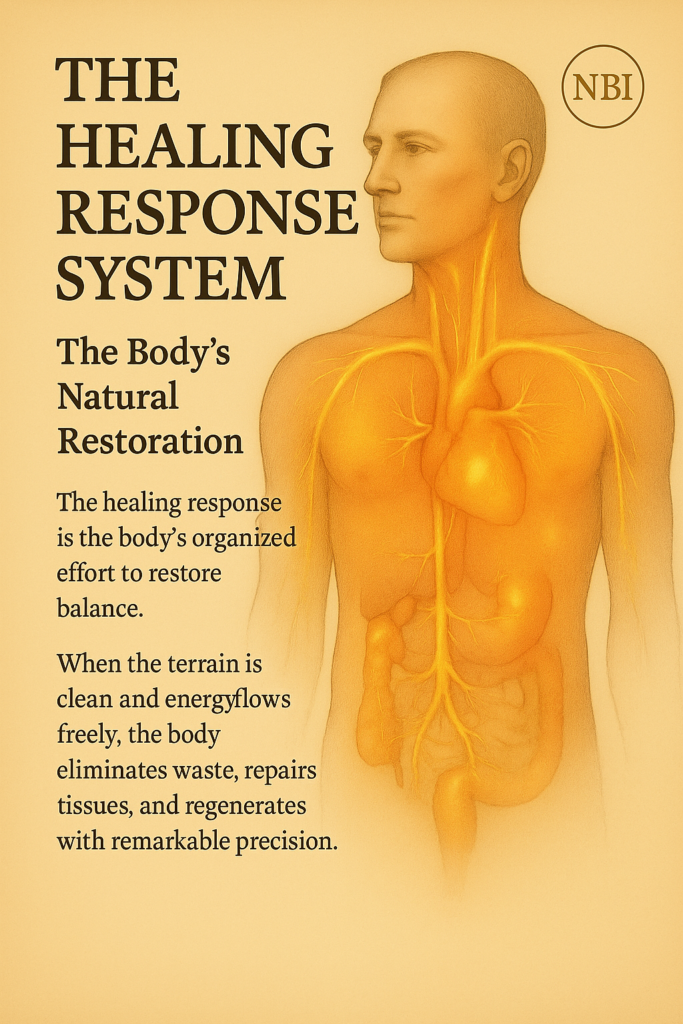
The “healing response system” is not a separate anatomical organ system. It is an NBI term for the coordinated activity of cells, circulation, lymph, nerves, hormones, connective tissue and organs involved in protection, cleanup, repair and adaptation.
There Really Is a Cleanup Crew
Cells such as macrophages and other phagocytic cells engulf damaged material and cellular debris. Enzymes dismantle molecules. Autophagy recycles components inside cells. Apoptosis allows unwanted or badly damaged cells to be dismantled in a controlled way. Lymphatic vessels collect excess interstitial fluid and material from tissues. Repair cells rebuild extracellular matrix and damaged structures.
Natural Hygiene interprets these observations as evidence that the body possesses extensive internal machinery for maintenance and renewal. Conventional physiology describes many of the same processes within immunology, inflammation, wound healing, cell biology and tissue repair. The observations overlap even where the interpretation differs.
Inflammation: Purposeful, but Not Always Harmless
Redness, warmth, swelling and tenderness can arise because blood vessels, signalling molecules, fluid and cells are responding to tissue disturbance. Increased blood flow produces redness and warmth; vascular changes allow fluid and proteins to enter tissues; pain and tenderness can discourage further loading of an injured area.
This supports an important Natural Hygiene observation: inflammation is an organised biological response, not meaningless chaos. But a purposeful response can still become excessive, persistent or damaging. Chronic inflammation can contribute to tissue destruction and loss of function. “The body has a reason for this response” is therefore different from “the response can never become dangerous”.
Fever: A Regulated Change in Temperature
During fever, signalling molecules influence the hypothalamus and raise the body’s temperature set-point. The person may initially feel cold and shiver while heat production and conservation increase. This is a regulated physiological response rather than simply accidental overheating.
Natural Hygiene has historically interpreted fever as part of the body’s active healing response and emphasised rest rather than automatically treating the temperature itself as the enemy. Modern physiology likewise recognises that fever forms part of an organised response and can alter biological processes.
The distinction is that fever has not been shown to work primarily by “burning or dissolving accumulated toxins”, and fever is not always harmless. Very high temperatures, dehydration, serious underlying illness or fever in vulnerable people can require medical attention. Treating fever or its cause does not establish that waste is being forced deeper into the body.
Mucus: Protection, Transport and Elimination
Mucus is produced by specialised cells and glands. It traps particles, contains protective molecules, keeps surfaces moist and is moved by cilia in parts of the respiratory tract. Coughing, sneezing and swallowing help move mucus and the material it contains.
This gives Natural Hygiene’s description of mucus as an eliminative medium a genuine physiological foundation: material really can be trapped and transported out of exposed tissues. What does not automatically follow is that every increase in mucus represents stored dietary or metabolic toxins being expelled.
The Skin and Elimination
The skin participates in temperature regulation and sweat contains water, electrolytes and small amounts of metabolic products. It therefore has a genuine, although limited, excretory role.
Natural Hygiene traditionally interprets some eruptions as the body using the surface as an additional route of elimination. Conventional dermatology explains eczema, acne, hives, boils and other eruptions through different mechanisms involving the skin barrier, follicles, inflammation, vascular responses and other processes. The presence of something leaving through the skin does not by itself demonstrate that systemic toxins were deliberately redirected there.
Lymph Nodes and Tissue Cleanup
Lymph nodes filter lymph and provide sites where immune cells encounter and respond to material arriving from tissues. Nodes can enlarge when cellular activity within them increases.
Natural Hygiene can reasonably view the lymphatic network as part of the body’s cleanup and transport system. Enlarged nodes, however, should not automatically be interpreted as successful detoxification; persistent, unexplained or concerning enlargement deserves investigation.
White Blood Cells: More Than Soldiers
The popular “army” metaphor captures only part of what white blood cells do. Different cells recognise biological signals, engulf material, clear dead and damaged cells, coordinate inflammation, produce antibodies, interact with microorganisms and participate in wound repair.
Natural Hygiene emphasises their role as a cleanup and maintenance crew. Conventional immunology groups these same cells and processes within the immune system and also recognises their roles in debris clearance and tissue repair. The disagreement is therefore partly about how the overall activity is interpreted, not whether the cells exist.
Terrain Changes the Response
Sleep, nutrition, energy availability, age, metabolic health, smoking, alcohol, stress, circulation and previous tissue damage can all influence biological responses and recovery. Microorganisms also proliferate according to the conditions available to them: nutrients, oxygen, acidity, moisture, competing organisms and host tissues all affect microbial growth.
This is where the Natural Hygiene concept of terrain remains especially useful. A trigger never acts in a vacuum; it encounters a living organism with a particular history and internal environment. Terrain does not make every trigger irrelevant, but it helps explain why responses and outcomes can differ greatly between people.
Rest, Fasting and Vital Economy
Rest reduces some demands and changes how energy and resources are being used. Sleep produces characteristic changes in nervous-system, hormonal and metabolic activity. Fasting changes fuel use, insulin signalling and cellular recycling pathways such as autophagy.
Natural Hygiene describes this through physiological rest and the Law of Vital Economy: reducing unnecessary demands may create different conditions for maintenance and recovery. It does not mean every unit of energy saved from digestion is transferred directly into healing, or that fasting is appropriate during every illness.
Purpose Does Not Mean Perfection
The strongest Natural Hygiene position is not that every symptom is harmless or that the body can never produce a damaging response. It is that many symptoms and biological reactions have understandable functions and should be investigated rather than dismissed as meaningless malfunctions.
The body contains remarkable machinery for cleanup, repair, adaptation and renewal. Natural Hygiene asks what conditions allow that machinery to work well, what burdens repeatedly disturb the terrain, and what unnecessary interference can be removed while still recognising situations in which the response itself or its underlying cause requires treatment.