
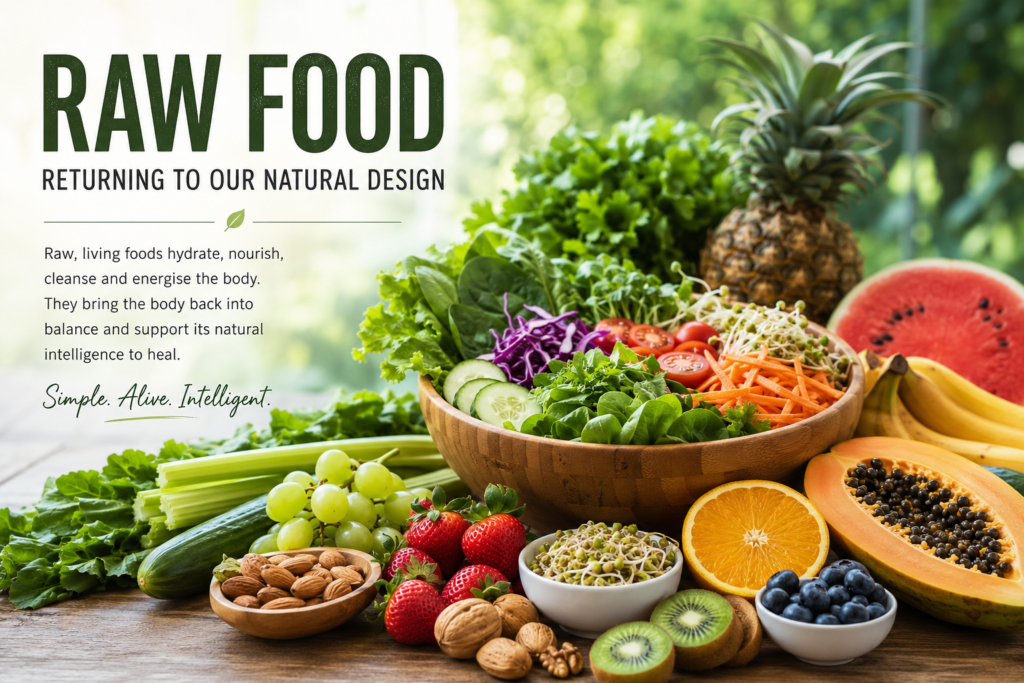
What is raw food?
Raw food is food that has not been cooked, processed, refined, preserved, fried, baked, roasted, or altered beyond recognition.
In simple terms, it means eating food as close as possible to the way nature created it.
Fresh fruit. Leafy greens. Tender vegetables. Sprouts. Herbs. Young coconuts. Avocados. Nuts and seeds when appropriate. Foods that still carry their water, fibre, colour, scent, structure, and natural intelligence.
Most people think of raw food as a diet.
I don’t.
Raw food is not just a diet. It is a return to biological simplicity.
It is the removal of the confusion.
When food is fresh, ripe, water-rich, and easy to recognise, the body does not need to work as hard to deal with it. Digestion becomes cleaner. Elimination becomes easier. Energy is no longer wasted trying to process heavy, dry, cooked, concentrated, salted, fatty, and chemically altered food.
And this is where everything starts to change.
Why raw food matters
The modern diet is not just cooked.
It is processed, preserved, concentrated, dehydrated, salted, sweetened, flavoured, fried, and packaged.
Then people wonder why the body struggles.
They feel tired. Bloated. Heavy. Inflamed. Constipated. Foggy. Sluggish. Irritable. Then they look for a supplement, a cleanse, a powder, a pill, or a protocol.
But often the body is not missing something complicated.
It is overwhelmed by what is being put in.
Raw food gives the body something very different. It gives the body food that still contains water, fibre, minerals, natural sugars, organic acids, antioxidants, colour pigments, and delicate plant compounds in a form that has not been heavily damaged by heat.
The World Health Organisation recommends at least 400g of fruit and vegetables per day for adults and children over 10, and says a healthy diet should include fruit, vegetables, legumes, nuts, and whole grains while reducing free sugars, salt, and unhealthy fats. (World Health Organization)
That is already a step in the right direction.
But Natural Hygiene goes further.
It asks a deeper question.
What happens when the majority of our food comes from living plants, in their fresh, raw, water-rich state?
Raw food and hydration
Most people think hydration means drinking more water.
Sometimes it does.
But true hydration is not just water going into the mouth. It is water entering the body in a form the body can use.
Fresh fruits and vegetables are naturally full of structured water, held within the fibre and cells of the plant. This is very different from trying to force litres of plain water into a body that is already overloaded with salt, stimulants, cooked food, and waste.
A watermelon hydrates differently from a glass of water.
An orange hydrates differently from tea.
A cucumber hydrates differently from a bottle of sports drink.
Raw food brings water, minerals, fibre, and natural sugars together. That combination supports movement through the digestive tract, helps soften waste, and makes elimination easier.
This is one reason people often notice changes quickly when they increase fruit and raw salads.
They are not just “eating healthier”.
They are finally giving the body water-rich food.
Raw food and digestion
Digestion is expensive.
Not financially.
Energetically.
Every heavy meal demands work. The body has to break it down, move it through, neutralise irritants, manage excess fats, deal with concentrated proteins, process salt, handle cooked starches, and clear what cannot be used.
Raw fruits are generally the easiest foods to digest when they are ripe, eaten properly, and not combined with heavy cooked meals.
They are high in water. They contain simple sugars. They leave the stomach relatively quickly. They do not require the same digestive burden as dense cooked foods.
This matters.
When digestion takes less effort, the body has more energy available for repair, cleansing, movement, thinking, and emotional regulation.
People often say, “I feel lighter.”
That is not just a feeling.
It is the body no longer being dragged into a digestive marathon after every meal.
Raw food and fibre
Fibre is one of the most misunderstood parts of food.
People talk about protein constantly, but fibre is quietly doing some of the most important work in the body.
Fibre gives bulk to the stool. It helps movement through the bowel. It slows the absorption of sugars. It feeds beneficial bacterial populations in the gut. It helps bind waste products and move them out. Harvard’s Nutrition Source describes fibre as having effects such as slowing digestion, delaying blood sugar rises after meals, supporting gut bacteria, and helping bowel movement. (The Nutrition Source)
Raw plant foods are naturally rich in fibre.
Not isolated fibre.
Not fibre added back into a processed cereal.
Real fibre, still woven into the structure of the food.
This is important because the body recognises whole food better than isolated fragments.
An apple is not just sugar and fibre.
It is water, pectin, minerals, acids, antioxidants, colour compounds, texture, scent, and life.
A salad is not just roughage.
It is mineral-rich plant material that helps clean the digestive tract and support elimination.
Most people are not suffering because they need a fibre supplement.
They are suffering because they have removed living plant food from the centre of their diet.
Raw food, minerals, and natural salts
The body needs minerals.
But it does not need them in the harsh, isolated, inorganic, overstimulating form most people use.
Salt is not the same as mineral-rich food.
Fresh greens, celery, cucumber, tomatoes, fruits, and vegetables contain minerals in organic form, bound within living plant tissues.
This matters because the body is not a chemistry set.
It is not just about throwing isolated substances into the system and hoping for the best.
Raw plant foods provide minerals with water, fibre, natural sugars, and plant compounds. They arrive in context.
That is how nature packages nutrition.
What cooking does to food
Cooking is not all the same.
Steaming vegetables is not the same as deep frying potatoes.
Lightly warming food is not the same as burning meat on a grill.
But heat does change food.
It softens fibre. It breaks down cell walls. It changes flavour. It can make some compounds easier to absorb. It can also damage heat-sensitive nutrients, destroy delicate enzymes, reduce water content, and create new chemical compounds when food is cooked at high temperatures.
Vitamin C is especially sensitive to heat and water. A study on cooking methods found that boiling destroyed vitamin C in many vegetables, with retention varying widely depending on the food and method used. (PMC)
This does not mean every cooked food is poison.
That kind of thinking becomes too rigid.
But it does mean raw food has a quality that cooked food cannot fully replace.
Fresh food carries a biological freshness that is lost when food is heated, dried, browned, fried, or preserved.
The more we cook, process, flavour, and manipulate food, the further we move from the original design.
Raw food and enzymes
Raw food contains enzymes.
Cooked food does not contain those same active enzymes in the same way, because heat denatures enzymes.
Now, mainstream nutrition often says food enzymes do not matter much because the body makes digestive enzymes.
There is some truth there.
The body does make digestive enzymes.
But the Natural Hygiene question is different.
Why would nature put enzymes, water, fibre, acids, sugars, minerals, and colour compounds into fresh food if we were meant to destroy that structure before eating it?
Raw food is not valuable only because of enzymes.
It is valuable because the entire food remains intact.
The enzymes are one part of that.
The living structure is the bigger picture.
Raw food and energy
People often say they want more energy.
Then they drink coffee, eat heavy cooked meals, snack on processed food, and wonder why they crash.
Energy is not something you drink.
Energy is something the body has when obstruction is reduced.
Raw food does not “give energy” in the stimulant sense. It supports energy by reducing the burden.
Less digestive stress. Less waste. Less dehydration. Less heaviness. Less need for compensation.
Fruit is especially important here.
Ripe fruit gives the body natural glucose, water, minerals, and fibre in a form that is simple to use. The brain and muscles run beautifully on glucose when it comes in a clean, water-rich, whole-food form.
This is why many people feel more alive when they increase fruit.
Not wired.
Alive.
There is a difference.
Raw food and detoxification
Detoxification has been turned into a market.
Foot pads. Powders. Teas. Binders. Capsules. Cleanses. Gadgets. Programmes.
But the body is not waiting for a product to detox.
The body is always trying to cleanse, repair, regulate, and restore balance.
Raw food helps because it removes the load and supports the channels of elimination.
More water-rich food means better bowel movement.
More fibre means better waste removal.
Less salt means less water retention and irritation.
Less fat means cleaner blood flow and easier digestion.
Less cooked, concentrated food means less residue for the body to deal with.
In Natural Hygiene, detoxification is not something you force.
You create the conditions, and the body does the work.
That is the difference.
Raw food and weight
Raw food naturally changes the way people eat.
It is difficult to overeat fresh fruit and salad in the same way people overeat pizza, bread, cheese, crisps, biscuits, and cooked fatty meals.
Raw food has volume.
It has water.
It has fibre.
It requires chewing.
It fills the stomach without creating the same dense calorie load as processed food.
This is one reason raw food diets are often associated with lower body weight. A 2022 study of strict raw food eaters found they had lower average BMI and body fat percentage compared with a reference group, though the study also found lower intakes of some nutrients such as protein, calcium, and iodine, and lower blood levels of zinc and vitamin D3. (PMC)
That last part matters.
Raw food can be powerful, but it still has to be done intelligently.
You cannot just eat lettuce and dates and pretend that is a complete lifestyle.
The body needs enough calories. Enough variety. Enough greens. Enough minerals. Enough rest. Enough sunlight. Enough warmth. Enough emotional steadiness.
Raw food is not magic.
It is a foundation.
Is a 100% raw diet necessary?
For some people, 100% raw feels amazing.
For others, it becomes stressful, socially difficult, or too restrictive.
The aim is not to win a purity contest.
The aim is to reduce obstruction and increase vitality.
A person eating 70% raw, with plenty of fruit, large salads, simple meals, good sleep, fresh air, movement, and low stress may do far better than someone eating 100% raw but living in fear, restriction, under-eating, and obsession.
This is important.
Natural Hygiene is not about making food into a religion.
It is about understanding cause and effect.
The more fresh, raw, ripe, water-rich plant food you eat, the more you support the body’s natural processes.
The more cooked, salted, fatty, processed, dry, stimulating, and chemically altered food you eat, the more the body has to compensate.
That is the basic principle.
The best raw foods to build your diet around
The simplest place to start is fruit.
Ripe bananas, oranges, apples, pears, mangoes, grapes, melons, berries, papaya, figs, dates, peaches, nectarines, cherries, and seasonal fruits.
Fruit is not the enemy.
Refined sugar is not fruit.
Sweets are not fruit.
Cake is not fruit.
Fruit comes with water, fibre, minerals, antioxidants, organic acids, and natural sugars in a complete package.
Then add tender greens.
Lettuce, romaine, spinach, rocket, watercress, celery leaves, parsley, coriander, basil, and other soft green leaves.
Then add watery vegetables.
Cucumber, tomatoes, peppers, courgette, celery, grated carrot, and similar foods.
Then use richer foods carefully.
Avocado, nuts, seeds, tahini, coconut, olives, and dried fruits can be useful, but they are concentrated. Many people feel worse on raw food because they replace cooked food with too many fats, nuts, raw desserts, oils, and dehydrated snacks.
That is not the same as living on fresh raw food.
A raw cheesecake is not the same as a bowl of oranges.
Let’s be honest about that.
Common mistakes people make with raw food
The biggest mistake is under-eating.
People remove cooked food, but they do not replace the calories properly. Then they feel weak and blame raw food.
Fruit has fewer calories per bite than bread, pasta, oil, or cooked grains.
So you often need more volume.
Another mistake is too much fat.
Raw does not automatically mean light. A meal made from nuts, seeds, oils, avocado, and dried fruit can be extremely heavy.
Another mistake is poor food combining.
Fruit after a heavy meal often ferments and causes bloating. Melons eaten after cooked food can feel awful. Acid fruits mixed with heavy fats can slow everything down.
The body is not confused.
The combinations are.
Another mistake is rushing.
If someone has spent decades eating cooked, salty, fatty, processed food, the body may react strongly when things suddenly change. Elimination may increase. Energy may fluctuate. Bowels may shift. Emotions may surface.
This does not mean the body is failing.
It may mean the body finally has enough energy to start clearing.
But the pace matters.
How to start eating more raw food
Start with breakfast.
Make breakfast fruit.
Not cereal. Not toast. Not coffee and biscuits.
Fruit.
Eat enough of it. Not one apple and then call raw food unsustainable.
Have bananas. Melon. Oranges. Mangoes. Grapes. Whatever is ripe and available.
Then make lunch lighter.
A large salad with fruit earlier in the day works well for many people.
Then simplify dinner.
If you still eat cooked food, make it simple. Steamed vegetables, potatoes, or a plain cooked meal alongside a raw salad is very different from fried food, sauces, cheese, meat, bread, and dessert.
Over time, increase the raw.
Do it with intelligence.
The body likes rhythm.
It does not always like shock.
Raw food and the Natural Hygiene view of healing
From the Natural Hygiene perspective, the body is intelligent.
Symptoms are not random attacks.
They are signals, compensations, clear-outs, pressure releases, and attempts to restore order.
When we eat raw food, we are not “treating disease”.
We are changing the conditions.
We are reducing the burden.
We are giving the body cleaner fuel.
We are creating space for elimination.
We are stepping out of the constant cycle of stimulation and suppression.
That is why raw food can feel so powerful.
Not because it attacks symptoms.
Because it stops adding so much to the problem.
Raw food is not about perfection
You do not need to become extreme overnight.
You do not need to argue with everyone.
You do not need to announce a new identity.
Just start eating more living food.
Start noticing.
How does fruit feel in the morning?
How does a large salad affect your digestion?
How do you sleep after a lighter evening meal?
How does your body feel when you reduce salt, fat, processed food, and stimulants?
Your body will teach you.
That is the part most people miss.
They keep looking for experts, plans, powders, scans, and opinions.
But the body is giving feedback all the time.
Raw food makes that feedback easier to hear.
Final thoughts
Raw food brings us back to something simple.
Food should not exhaust the body.
It should support it.
It should hydrate, nourish, cleanse, and move through cleanly.
It should leave us clearer, not heavier.
This is why raw food sits at the heart of Natural Body Intelligence.
Not as a trend.
Not as a punishment.
Not as a purity test.
As a return to the foods the body recognises most easily.
Fresh. Ripe. Water-rich. Simple. Alive.
When you start eating this way, you begin to realise something.
The body was never asking for complicated.
It was asking for the conditions to do what it already knows how to do.
Continue Exploring
- What Is Natural Hygiene?
- Digestive Health & Food Combining
- Digestive System
- Raw Meal Ideas
- Vital Economy