
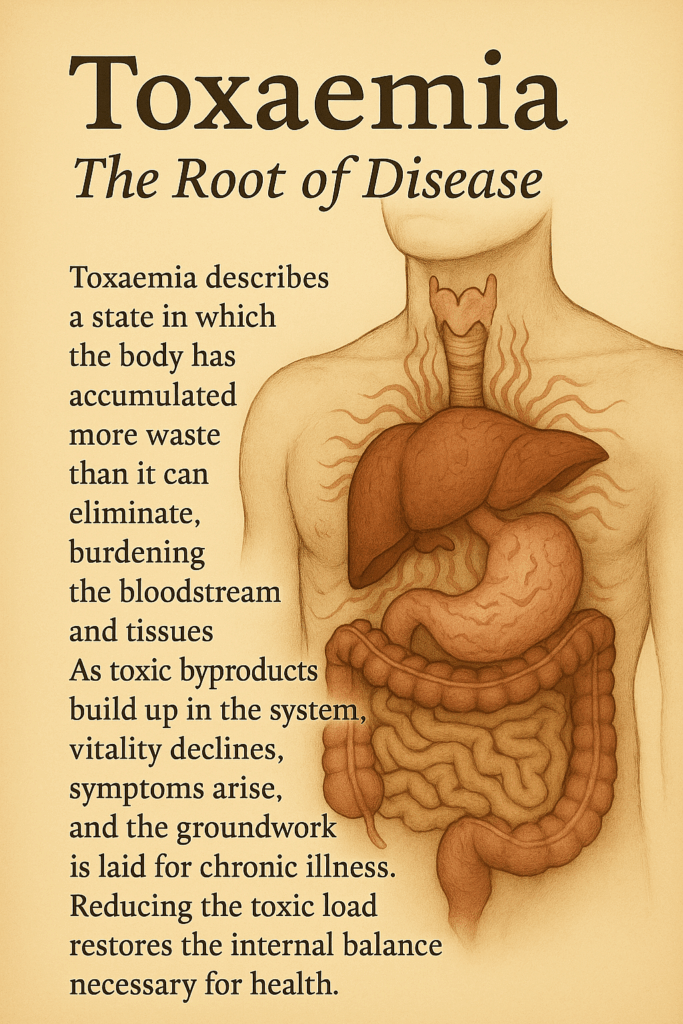
Toxaemia: The Root of Disease in Natural Hygiene
Toxaemia is one of the central concepts in Natural Hygiene. It describes a state in which the total burden created by normal metabolism, environmental exposures and unhealthy living is understood to exceed the body’s comfortable capacity for processing, regulation and elimination.
Natural Hygiene uses this concept to shift attention from the disease label alone to the terrain in which symptoms develop: sleep, food, digestion, movement, stress, stimulation, environmental exposures, elimination and the person’s overall state of vitality.
It is important to understand what kind of claim this is. The body unquestionably produces metabolic by-products and continually processes and eliminates substances through the liver, kidneys, lungs, digestive tract and other tissues. Toxaemia is the broader Natural Hygiene interpretation of what happens when the total physiological burden becomes excessive; it is not one specific toxin or a single laboratory measurement.
Watch: The Nature of Disease, Toxicosis and Detox
This Natural Body Intelligence video explores toxicosis, detoxification and the Natural Hygiene view of disease.
The Physiological Foundation
Every cell generates products of metabolism. Carbon dioxide is carried to the lungs. Nitrogen-containing products are processed and excreted through the kidneys. The liver transforms many internally produced and externally absorbed compounds. The digestive tract removes unabsorbed material and substances entering through bile and intestinal secretions.
Circulation and tissue fluid continually transport substances between cells and these processing organs. Hydration supports plasma volume and kidney filtration, while movement contributes to circulation and lymphatic fluid return. These are observable examples of the body’s constant work to maintain its internal environment.
The Natural Hygiene Interpretation
Natural Hygiene takes these processes further and argues that health depends on keeping the overall burden within the body’s capacity to regulate and eliminate it. Overeating, alcohol, smoking, inadequate sleep, chronic stress, continual stimulation, inactivity and harmful environmental exposures can all add demands or interfere with normal regulation in different ways.
Within this framework, toxaemia is not simply “poison in the blood”. It is a whole-terrain concept: inputs, metabolic demands, processing, circulation, elimination and recovery are considered together.
Enervation and Vital Economy
Natural Hygiene closely links toxaemia with enervation and the Law of Vital Economy. When demands remain high and opportunities for recovery are inadequate, the body must continually prioritise its available resources. Sleep loss, overwork, stress, pain and continual stimulation can measurably alter metabolism, appetite, hormonal signalling, nervous-system activity and behaviour.
Natural Hygiene interprets this as reduced capacity for normal maintenance and elimination. The useful principle is not that the body has a literal battery of “vital energy” that runs flat, but that biological resources and regulatory capacity are finite at any given moment and are continually allocated according to need.
Are Acute Symptoms the Body Cleaning Itself?
This is where Natural Hygiene makes one of its most distinctive interpretations. Coughing can expel mucus and irritants. Vomiting and diarrhoea can rapidly remove material from the digestive tract. Fever changes metabolism and behaviour. Loss of appetite reduces food intake. Fatigue encourages inactivity and rest. Inflammation coordinates blood flow, signalling and tissue responses.
These observations show that many symptoms are active biological responses rather than meaningless failures. That is an important Natural Hygiene insight.
What the observations do not establish is that every fever, rash, cough or episode of diarrhoea is specifically the body expelling accumulated metabolic toxins. A response can be purposeful and protective while also arising from tissue injury, microorganisms, allergens or other identifiable triggers. It can also become severe enough to cause harm.
Toxaemia and Chronic Disease
Natural Hygiene views chronic disease through the history of the terrain rather than treating it as a completely isolated event. This has useful parallels with what is known about long-term risk: smoking, alcohol, metabolic dysfunction, high blood pressure, inactivity, poor sleep, some dietary patterns and environmental exposures can progressively alter tissues and disease risk.
The Natural Hygiene interpretation is that persistent adverse conditions create an increasingly unfavourable internal environment. However, individual chronic conditions have distinct mechanisms. A kidney stone can contain crystallised urinary substances, a fatty liver contains accumulated triglyceride and an atherosclerotic plaque contains lipids, inflammatory cells and fibrous tissue. A cyst, tumour or hardened joint should not automatically be described as a container deliberately constructed to store unspecified toxins.
Food, Hydration and Elimination
Natural Hygiene traditionally favours simple, minimally processed, water-rich plant foods. Fruit and vegetables provide substantial water alongside nutrients and fibre. That fluid contributes to hydration, plasma volume and the water available for kidney filtration and urine production.
This is a concrete way in which water-rich food can support the conditions for circulation and elimination. It is more precise than saying fruit chemically washes toxins from the blood.
Rest and Fasting
Rest reduces physical demands, while sleep changes nervous-system, hormonal and metabolic activity. Fasting stops the continual intake and digestion of food and shifts the body towards stored fuels. Natural Hygiene interprets these changes as physiological rest and an opportunity for the body’s maintenance processes to operate under different conditions.
The body continues metabolising, circulating, filtering and excreting throughout a fast. Fasting therefore does not need to be described as a magical purge to have physiological significance. It is also not suitable for every person or every condition.
The Central Natural Hygiene Question
Rather than asking only, “What disease do I have?”, Natural Hygiene asks: What conditions is my body living in, what demands are being placed upon it, and which of those conditions can be improved?
That question captures the practical value of the toxaemia model. It directs attention towards the terrain — nourishment, rest, movement, air, light, emotional strain, harmful exposures, elimination and recovery — while allowing the mechanisms of individual conditions to be examined honestly rather than forcing every symptom into one explanation.