
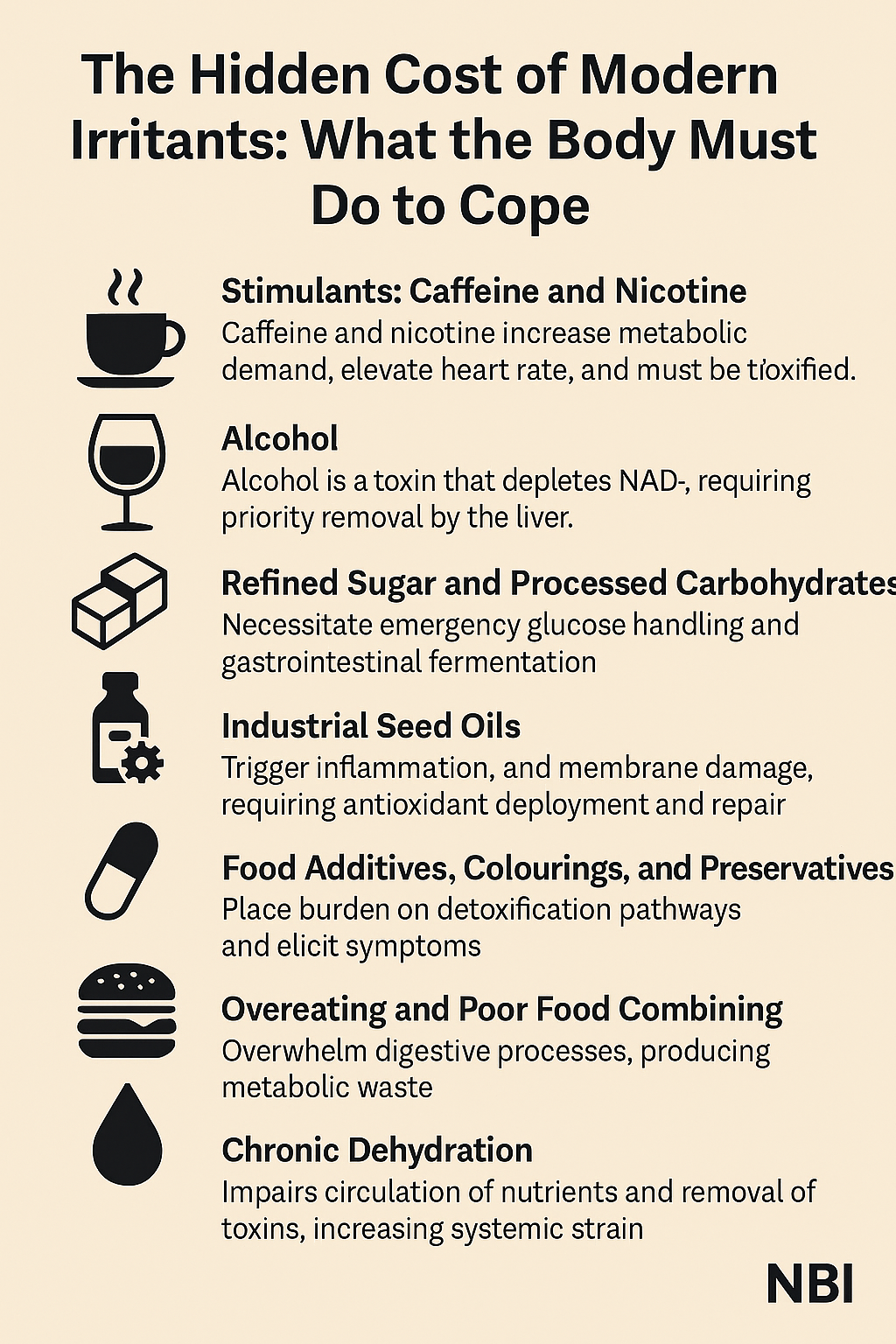
Every substance that enters the body requires biological effort. Some inputs nourish, hydrate and support life with very little cost. Others place a heavy demand on digestion, detoxification, elimination and nervous regulation. Modern life is saturated with irritants that are rarely recognised as such because they are normalised, legal, marketed or socially accepted. The body, however, does not negotiate. It must respond to every input using energy, enzymes, minerals, water and nervous resources.
Watch: A Journey Inside a Toxic Body
This Natural Body Intelligence video provides useful context for understanding what happens when the body is repeatedly exposed to substances and lifestyle inputs it must continually process, manage and eliminate.
This article explores common irritants people regularly put into their bodies and the biological work required to manage them.
Stimulants: Caffeine and Nicotine
Caffeine, found in coffee, tea, energy drinks and pre-workout products, is not a source of energy. It is a nervous stimulant that forces alertness by triggering stress chemistry. Once ingested, the liver must metabolise caffeine using cytochrome P450 enzymes. This process requires minerals, particularly magnesium, and places a direct workload on liver cells.
Caffeine also increases adrenal output, elevates heart rate and mobilises glucose reserves. The body is pushed into a temporary state of heightened activity that must later be compensated for through rest. The “crash” many people feel is not caffeine wearing off, but the body attempting to restore balance.
Nicotine acts similarly, stimulating the nervous system and constricting blood vessels. It reduces oxygen delivery while increasing metabolic demand. Detoxifying nicotine requires liver conjugation pathways and increases the need for antioxidants. Energy is diverted away from repair and regeneration towards damage control.
Alcohol
Alcohol is a direct cellular toxin. It provides no nutritional value and must be prioritised for removal as soon as it enters the bloodstream. The liver converts alcohol into acetaldehyde, a substance more toxic than alcohol itself, before converting it again into acetate for elimination.
This process consumes large amounts of NAD+, an essential molecule also required for cellular energy production and repair. When NAD+ is diverted to alcohol metabolism, less is available for healing processes. Alcohol also dehydrates tissues, thickens blood, irritates the digestive tract and increases intestinal permeability, all of which require additional repair work.
Refined Sugar and Processed Carbohydrates
Refined sugar enters the bloodstream rapidly, bypassing the slow digestive rhythms the body is designed for. This sudden influx forces emergency glucose handling, storage and regulation. Minerals such as chromium, magnesium and zinc are required to process sugar, and repeated exposure can deplete reserves.
Beyond blood sugar effects, refined carbohydrates ferment easily in the digestive tract, producing gas, acids and metabolic waste. The bowel must move this material along, the liver must process by-products, and elimination pathways must cope with increased load. Energy that could support cellular renewal is instead spent managing excess.
Industrial Seed Oils
Highly processed seed oils such as sunflower, rapeseed and soybean oil are chemically unstable and prone to oxidation. Once consumed, these oxidised fats integrate into cell membranes, where they increase inflammation signalling and reduce membrane integrity.
The body must deploy antioxidant systems to neutralise lipid peroxidation. This consumes vitamin E, glutathione and enzymatic resources. Repairing damaged membranes requires further energy and raw materials, adding to systemic load.
Food Additives, Colourings and Preservatives
Artificial additives are foreign to human biology. Emulsifiers, flavour enhancers, colourings and preservatives are not recognised as food and must be detoxified. Many are processed through phase I and phase II liver pathways, requiring amino acids, sulphur compounds and energy.
When additive exposure is chronic, detoxification pathways can become congested. Symptoms often appear far from the source, manifesting as skin issues, headaches, digestive discomfort or fatigue. The body is signalling that its capacity is being exceeded.
Pharmaceutical Drugs
While drugs may suppress symptoms, they always require metabolic handling. Most are processed through liver enzyme systems and excreted via kidneys or bile. This places ongoing demand on these organs and increases the need for hydration.
Drugs can also interfere with nutrient absorption, enzyme function and nerve signalling. The body must adapt continuously to altered chemistry, diverting energy away from natural regulatory processes.
Overeating and Poor Food Combining
Even biologically appropriate foods become irritants when eaten excessively, too frequently or in incompatible combinations. Digestion is energy-intensive. Producing enzymes, acids and peristaltic movement requires nervous coordination and blood flow.
When food intake exceeds digestive capacity, fermentation and putrefaction occur. This creates metabolic waste that must be neutralised and eliminated. The bowel, liver and kidneys are placed under additional strain, often leading to sluggish elimination and systemic fatigue.
Chronic Dehydration
Water is not merely a fluid but a transport medium for nutrients and waste. Inadequate hydration thickens blood, slows lymphatic movement and concentrates toxins. The body must expend more energy to circulate fluids and remove waste, increasing strain on every system.
Hydrating foods, particularly fruits, provide structured water that supports cellular function with minimal effort.
The Energy Trade-Off
The body has finite energy. When it is forced to constantly neutralise irritants, less energy remains for growth, repair, adaptation and clarity of mind. Symptoms are not failures but intelligent signals that resources are being misallocated under pressure.
Health improves not by adding more interventions, but by reducing unnecessary burdens. When irritants are removed, the body naturally reallocates energy towards restoration. This is the central principle of Natural Body Intelligence: support the conditions for life, and life does the rest