
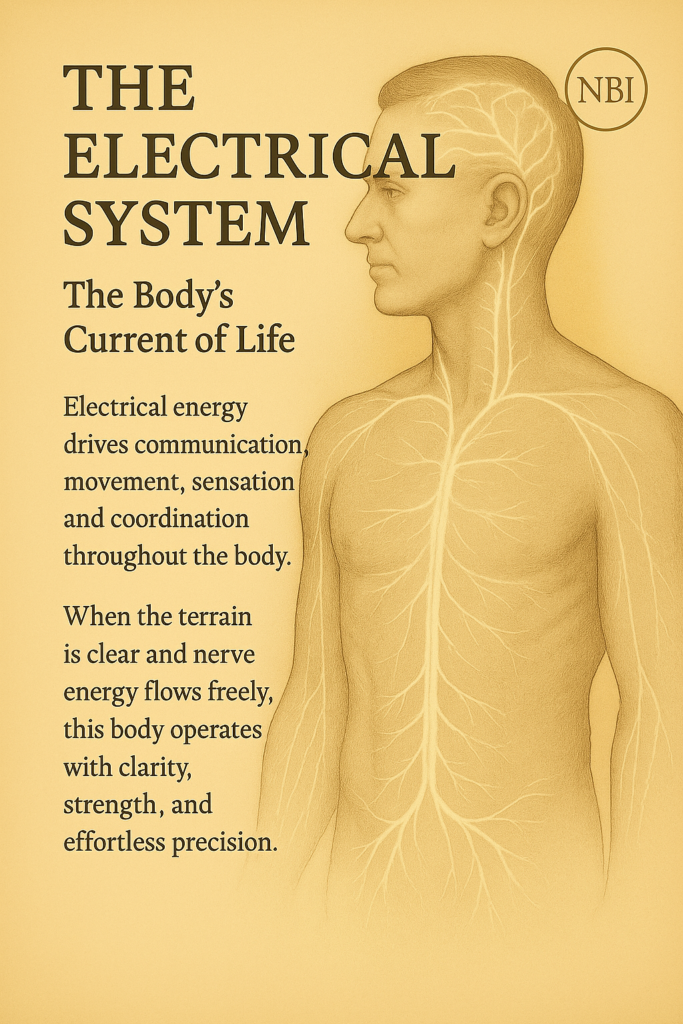
The Electrical System: Charge, Communication and the Living Terrain
The body is profoundly electrical. Every nerve impulse, heartbeat and muscle contraction depends on controlled movement of charged ions across cell membranes. Although anatomy does not classify an “electrical system” as a separate organ system, bioelectric activity runs through many of the body’s recognised systems.
Cellular Voltage Is Real
Cells maintain differences in electrical charge across their membranes, known as membrane potentials. These gradients depend largely on the controlled distribution of ions such as sodium, potassium, calcium and chloride.
In nerve and muscle cells, rapid changes in membrane potential create action potentials that transmit information or trigger contraction. This is measurable physiology and provides a genuine biological foundation for talking about the body’s electrical nature.
It is too simple, however, to say that a general fall in “cellular voltage” caused by toxins or acidity explains fatigue and disease. Different cells maintain different potentials, and serious disturbances usually involve identifiable changes in ion balance, membrane function, metabolism or tissue damage.
Minerals and Electrolytes
Sodium, potassium, calcium, magnesium and chloride are essential to electrical signalling, muscle contraction and fluid balance. The kidneys, hormones and digestive system regulate their concentrations tightly.
Fruits and vegetables can contribute potassium, magnesium, water and other nutrients. This fits Natural Hygiene’s emphasis on supplying the conditions and raw materials the body uses for self-regulation. Supplements are not universally unnecessary, however; genuine deficiencies or electrolyte disturbances sometimes require specific treatment.
Hydration and Conductivity
Body fluids contain dissolved ions and provide the aqueous environment in which electrical and chemical processes occur. Water-rich fruit can make a meaningful contribution to hydration and therefore to normal fluid and electrolyte balance.
The water in fruit does not need to be described as a special form of “structured water” that conducts life energy differently from ordinary water. Once absorbed, water joins the body’s regulated fluid compartments.
The Heart’s Electrical Rhythm
The sinoatrial node normally initiates each heartbeat, and specialised conduction pathways coordinate contraction through the heart. This electrical activity can be recorded with an ECG.
Stress, stimulants, electrolyte disturbances, medicines, heart disease and many other factors can affect rhythm. Palpitations are therefore not simply evidence of emotional or toxic “electrical incoherence”. Persistent, severe or new palpitations deserve appropriate assessment.
The Nervous System: Electrochemical Communication
Nerves use electrical changes along cell membranes and chemical neurotransmission between cells. The nervous system is therefore better described as electrochemical than as electrical wiring alone.
Sleep, metabolic health, adequate nutrition and recovery all influence nervous-system function. This gives Natural Hygiene’s concepts of terrain and enervation a useful whole-person context without implying that every neurological symptom is simply low electrical charge.
Fasting and Electrical Regulation
Fasting changes metabolism and hormone signalling, but it does not simply “recharge” cells. Prolonged fasting can also alter fluid and electrolyte balance, particularly when combined with illness, medicines or inadequate reserves.
A Bioelectric Organism
The important Natural Hygiene insight remains: the body is not merely a collection of mechanical parts. Cells maintain electrical gradients, tissues communicate, and the organism continuously regulates its internal conditions. Bioelectricity is one genuine part of that integrated self-regulation.