
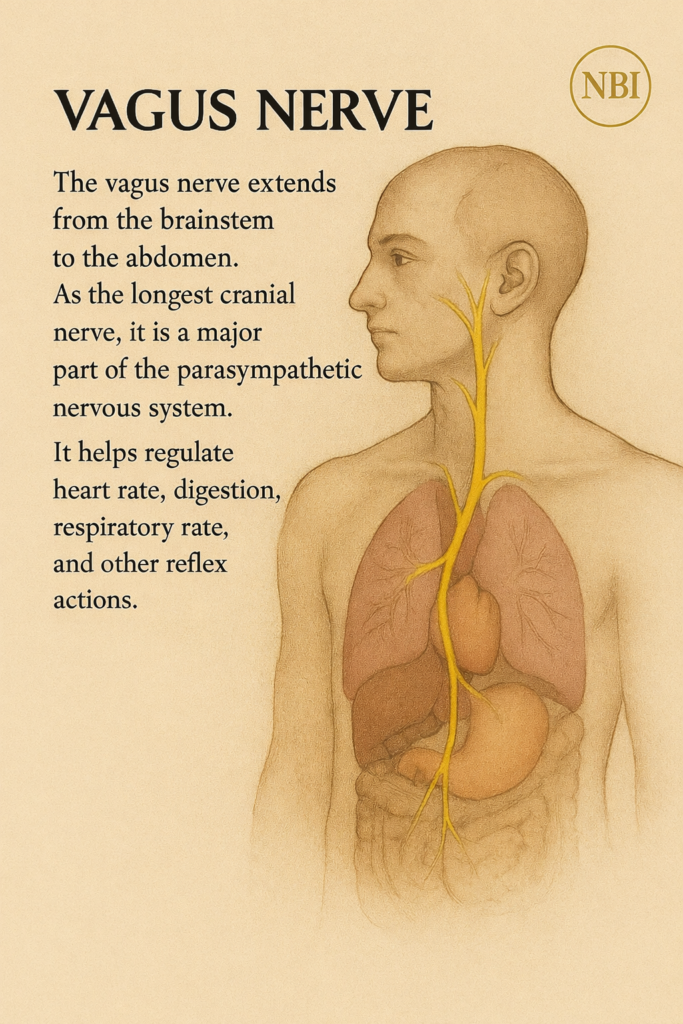
The vagus nerve is one of the most extensive and important communication pathways in the human body. It travels from the brainstem, passes through the neck, and continues into the chest and abdomen, connecting the brain with the throat, heart, lungs, stomach, liver, pancreas, and intestines.
Its name comes from the Latin word for wandering, reflecting the long journey it takes through the body.
In Natural Hygiene, the vagus nerve is not simply viewed as an electrical cable carrying isolated messages. It is part of the body’s wider communication network, continually exchanging information between the brain, the organs, the digestive system, and the internal terrain.
Messages travel in both directions.
The brain sends signals down through the vagus nerve, helping coordinate breathing, heart rhythm, swallowing, digestive activity, and the movement of food through the gastrointestinal tract.
At the same time, the organs send information back towards the brain, reporting what is happening inside the body.
This means the brain is not controlling the body from a distant command centre. It is constantly listening, responding, and adapting to the information arriving from the internal organs.
The vagus nerve is a major part of the parasympathetic nervous system, often described as the body’s rest-and-digest state.
When the body feels safe, breathing becomes calmer, the heart can settle, the muscles begin to soften, and more energy becomes available for digestion, maintenance, and repair.
This calmer state is not weakness or inactivity.
It is the condition in which many of the body’s most important restorative processes can take place.
The opposite state is commonly described as fight or flight.
When the body detects pressure, danger, emotional conflict, or intense stimulation, it prepares for action.
The heart may beat more quickly.
Breathing may become shallow.
Muscles tighten.
Blood flow and energy are redirected towards immediate survival.
Digestion may slow, accelerate, or become irregular.
This response is not a mistake.
It is a protective adaptation designed to help the body respond to a temporary challenge.
Problems arise when the challenge is no longer temporary.
Many people now remain in a state of continual stimulation from the moment they wake until the moment they sleep.
Noise, screens, work pressure, unresolved emotional tension, rushing, stimulants, financial worries, relationship difficulties, poor sleep, and constant information all keep the nervous system activated.
The physical danger may not be real, but the body still responds to the signals it receives.
Over time, this can create a condition in which the body struggles to move fully into rest, digestion, and recovery.
A person may feel tired but unable to relax.
Their body may be still, while internally everything remains tense.
The vagus nerve is deeply connected with digestion.
It helps coordinate the movement and activity of the stomach and intestines and carries information between the digestive organs and the brain.
This is why emotional pressure can be felt so quickly in the stomach.
Someone may lose their appetite during anxiety.
They may experience nausea before an important event.
Their bowel may become urgent, sluggish, bloated, or uncomfortable during periods of stress.
The food may not have changed, but the nervous system has.
The body does not separate emotional experience from digestion.
It responds as one connected organism.
The vagus nerve also communicates with the heart and lungs.
It participates in the regulation of heart rhythm and carries signals connected with breathing and pressure within the chest.
When someone is calm, breathing tends to become slower and more relaxed.
When they are frightened or tense, breathing becomes shorter, higher, and more rapid.
Breathing is particularly important because it happens automatically, but it can also be influenced consciously.
A slow, comfortable breath with a relaxed, slightly longer exhalation can help create a different internal message.
It does not force the body to relax.
It creates conditions that may allow the body to recognise that immediate danger is not present.
The throat and voice are also connected with the vagus nerve.
Branches of the nerve help coordinate swallowing and movement of the vocal cords.
This is why intense emotion can sometimes be felt as tightness in the throat, difficulty speaking, a weak voice, or the sensation of a lump that is not physically blocking the airway.
The body is expressing tension through the structures involved in breathing, speaking, and swallowing.
The vagus nerve forms part of what is often called the gut-brain connection.
The digestive tract is continually sending information towards the brain about fullness, movement, irritation, pressure, and the internal environment.
The brain then responds through changes in appetite, mood, alertness, digestive activity, and behaviour.
The gut and brain are not two separate systems communicating occasionally.
They are in constant conversation.
When digestion becomes heavy, the nervous system feels it.
When emotional strain increases, the digestive system feels it.
This is why simply treating one digestive symptom without considering the person’s emotional state, sleep, breathing, and daily pressures may miss an important part of the picture.
The body never divides itself into isolated compartments.
Stress within one system creates adaptation throughout the whole.
The vagus nerve is sometimes presented online as something that can be instantly reset with one technique.
The body is rarely that simple.
Cold water, humming, chanting, singing, massage, breathing exercises, or meditation may create temporary changes in breathing, heart rhythm, attention, or muscular tension.
But no short exercise can cancel out a life built around constant stimulation, poor sleep, emotional strain, heavy food, alcohol, caffeine, and lack of recovery.
The nervous system responds most powerfully to the conditions repeated every day.
Regular sleep gives the body time to move away from constant alertness.
Natural movement helps release muscular tension and supports circulation.
Quiet breathing reduces unnecessary effort.
Eating slowly and without distraction allows digestion to take place under calmer conditions.
Simple, water-rich food reduces the digestive burden.
Time outdoors gives the eyes, brain, and nervous system a break from artificial stimulation.
Safe relationships and honest emotional expression also matter.
The body cannot be forced to feel safe while continually living in conditions that communicate danger.
The goal is not to stimulate the vagus nerve harder.
The goal is to remove some of the interference preventing the nervous system from moving naturally between activity and rest.
The body needs both states.
It needs alertness when action is required.
It needs calm when digestion, sleep, repair, and recovery are required.
Health depends on being able to move between them.
When someone remains trapped in constant tension, the message is not that their body is broken.
The body is adapting to what it believes is happening.
It is maintaining readiness because the signals of pressure have not stopped.
When those signals begin to change, the body can begin to respond differently.
This is why slowing down can initially feel uncomfortable.
A person who has lived in constant stimulation may experience stillness as unfamiliar or even threatening.
The nervous system needs consistency.
Calm cannot always be created in one afternoon.
It is learned through repeated experiences of rest, safety, nourishment, movement, natural light, and reduced stimulation.
As the internal terrain becomes calmer, many people notice that digestion becomes easier, breathing becomes deeper, sleep improves, and emotional reactions become less intense.
This does not mean that every symptom comes from the vagus nerve.
Persistent fainting, severe breathlessness, chest pain, difficulty swallowing, unexplained vomiting, new speech changes, or continuing digestive problems need proper medical investigation.
Symptoms should be listened to, not casually labelled as stress or detoxification.
The vagus nerve teaches us that communication is happening throughout the body every moment.
The brain listens to the organs.
The organs respond to the brain.
Breathing changes the nervous system.
Emotional tension changes digestion.
Digestion influences mood and energy.
Nothing happens alone.
The vagus nerve is the body’s wandering communication highway, linking thought, emotion, breathing, circulation, and digestion.
When life becomes constantly rushed, the signals become dominated by urgency.
When we create space for rest, the entire system receives a different message.
The body is not asking to be controlled.
It is asking to be heard.
How This System Communicates Stress
- Digestive discomfort, nausea, bloating, or heaviness
- Constipation, urgency, or irregular bowel movements
- Shallow breathing or difficulty taking a relaxed breath
- Tightness in the throat or changes in the voice
- Dizziness, faintness, or feeling light-headed
- Heart palpitations or noticeable changes in heart rhythm
- Fatigue combined with an inability to relax
- Emotional sensitivity, anxiety, or nervous tension
- Sleep disruption and waking without feeling restored
Conditions Commonly Associated With the Vagus Nerve
- Gastroparesis
- Vasovagal syncope
- Dysautonomia
- Functional dyspepsia
- Irritable bowel syndrome
- Chronic digestive discomfort
- Difficulty swallowing
- Voice and vocal-cord dysfunction
- Abnormal autonomic heart-rate regulation
Systems That Work Closely With the Vagus Nerve
- Nervous system
- Digestive system
- Heart and circulatory system
- Respiratory system
- Endocrine system
- Microbiome system
- Emotional system
The vagus nerve arises from the brainstem and carries motor, sensory, and parasympathetic signals involving the throat, heart, lungs, and gastrointestinal tract. It is central to two-way communication between the organs and brain, while vagus-nerve damage can contribute to conditions such as gastroparesis and vasovagal syncope.