And Why Breathwork Matters in Healing
In Natural Hygiene, we understand that the body heals itself when the right conditions are provided.
One of the most important of those conditions is oxygen.
Yet many people today are under-oxygenated.
Not because oxygen is missing from the air.
But because stress, poor posture, shallow breathing, mouth breathing, sedentary living and constant tension change the way we breathe.
When breathing becomes shallow and restricted, the body receives less oxygen.
The tissues are less energised.
Elimination slows.
The nervous system stays on edge.
Fatigue increases.
And the body has less energy available for cleansing, repair and regeneration.
This matters because healing is not just about food.
It is not just about fasting.
It is not just about avoiding toxins.
The body also needs oxygen.
Without enough oxygen, the body cannot produce energy efficiently.
And without energy, the body cannot eliminate waste properly.
Watch: The Respiratory System — The Gatekeeper of Vital Energy
This Natural Body Intelligence video gives a broader overview of the respiratory system and provides useful context for the role of breathing and gas exchange discussed throughout this article.
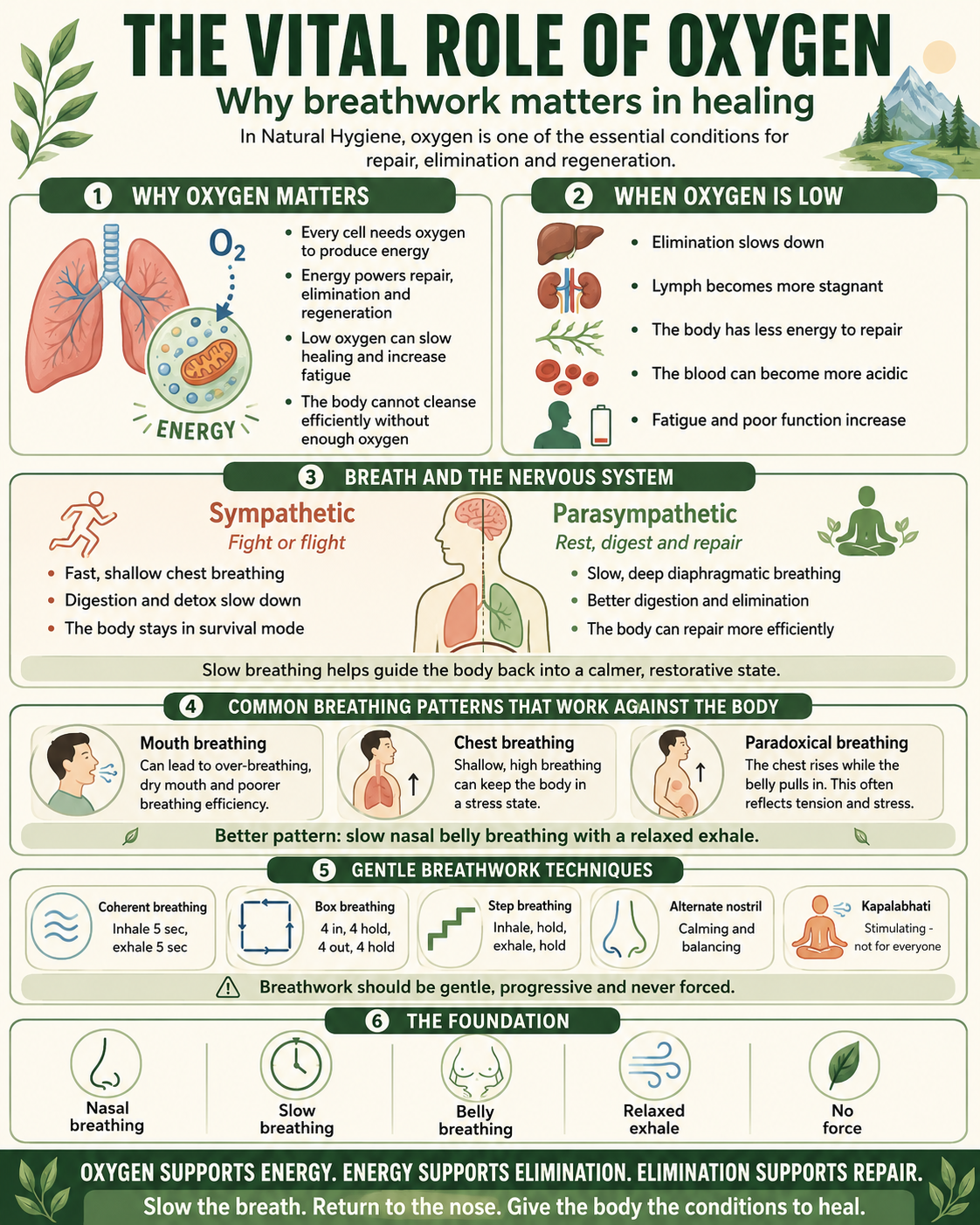
Oxygen: The Foundation of Cellular Energy and Detox
Oxygen is involved in almost every important process in the body.
Every cell depends on oxygen to produce ATP, which is the energy currency of the body.
This energy is needed for:
- Repairing tissue
- Breaking down waste
- Moving lymph
- Supporting bowel function
- Supporting kidney function
- Supporting lung elimination
- Maintaining blood quality
- Keeping the internal environment stable
The body is always trying to maintain balance.
But when oxygen is low, everything becomes harder.
The body has less energy to work with.
The organs of elimination become more burdened.
The lymphatic system becomes slower.
The blood can become more acidic.
Healing can slow down.
This is why breathwork matters.
It gives the body access to one of its most basic needs.
Oxygen.
Breath and the Nervous System
Breathing is unique.
It happens automatically, but we can also consciously influence it.
This makes the breath a bridge between the body and the mind.
It also gives us a direct way to influence the nervous system.
The autonomic nervous system has two main branches.
Watch: The Nervous System — How Your Body Really Works
This companion video provides additional context for the sympathetic and parasympathetic responses, stress patterns and nervous-system regulation explored in the sections below.
1. The Sympathetic Nervous System
This is the fight-or-flight state.
When this system is dominant, the body is focused on survival.
Heart rate increases.
Blood pressure rises.
Digestion slows down.
Elimination slows down.
Repair is put on hold.
Breathing becomes faster, shallower and higher in the chest.
Many people live in this state far too often.
Not for a few minutes.
But for years.
Rushing.
Worrying.
Overworking.
Arguing.
Overthinking.
Scrolling.
Drinking coffee.
Sleeping badly.
Eating under stress.
The body reads all of it.
And the breath changes with it.
2. The Parasympathetic Nervous System
This is the rest, digest and repair state.
When this system is active, the body can slow down.
Heart rate settles.
Breathing becomes deeper.
Digestion improves.
Elimination improves.
Repair becomes more possible.
The body starts moving out of emergency mode.
This is where healing happens more efficiently.
Breathwork helps guide the body back into this state.
Not by force.
By giving the nervous system a calm signal.
Slow breath tells the body:
“We are safe.”
And when the body feels safe, it can begin to repair.
Understanding Basic Breathing Physiology
Most adults breathe around 12 to 20 times per minute.
But in a calm, rested state, breathing often slows.
A useful aim during gentle breathwork is around 6 to 10 breaths per minute.
This encourages a more parasympathetic state.
The depth of the breath also matters.
Tidal volume is the amount of air moved in and out with each breath.
A relaxed, healthy breath moves air deeply and efficiently.
A shallow breather may only move a small amount of air with each breath.
This can leave the body under-oxygenated over time.
There are a few breathing patterns worth understanding.
Hypoventilation
This means breathing too little.
The body may not be moving enough air.
Carbon dioxide can build up.
Oxygen delivery can be reduced.
The body can feel heavy, tired and sluggish.
Hyperventilation
This means breathing too much or too quickly.
It is often mistaken for deep breathing.
But it can actually disturb the balance of gases in the blood.
Too much carbon dioxide may be lost.
This can lead to dizziness, tingling, anxiety, tightness and light-headedness.
More breathing is not always better.
Better breathing is better.
Hypoxia
Hypoxia means the tissues are not getting enough oxygen.
This can happen through poor breathing habits, low blood quality, toxic load, poor circulation, anaemia, stress, tension or other factors that interfere with oxygen delivery.
The body may still be breathing.
But the tissues may not be receiving what they need.
This is why we don’t just look at the breath as air coming in and out.
We look at whether the body is actually using oxygen properly.
Common Breathing Patterns That Work Against the Body
1. Paradoxical Breathing
This is when the chest rises and the belly pulls in during inhalation.
It is the opposite of natural diaphragmatic breathing.
It often shows a stress pattern in the body.
The body is breathing from tension rather than ease.
A better pattern is belly breathing.
The belly gently expands on the inhale.
The body softens.
The breath drops lower.
The exhale slows down.
2. Mouth Breathing
Mouth breathing often leads to over-breathing.
It can dry the mouth.
It can disturb sleep.
It can reduce the benefits of nasal breathing.
Nasal breathing is usually the better foundation.
The nose filters, warms and conditions the air.
It also supports nitric oxide production, which helps with oxygen delivery and blood vessel function.
As much as possible, breathing should return to the nose.
Especially at rest.
Especially during sleep.
Especially during gentle breathwork.
3. Chest Breathing
Chest breathing is shallow and high.
It often keeps the body in a mild stress state.
The shoulders lift.
The neck tightens.
The breath becomes short.
The body receives the signal that something is wrong.
Diaphragmatic breathing is different.
It is slower.
Lower.
Calmer.
More efficient.
It helps the body move back towards regulation.
Gentle Breathwork Techniques
Breathwork should not be aggressive.
The aim is not to force oxygen into the body.
The aim is to restore natural breathing, calm the nervous system and improve the conditions for healing.
Here are some simple techniques.
1. Coherent Breathing
This is slow, steady breathing at around 5 to 6 breaths per minute.
A simple rhythm is:
- Inhale for 5 seconds
- Exhale for 5 seconds
No strain.
No force.
Just a steady, even rhythm.
This can help calm the nervous system, improve heart rate variability and bring the body into a more balanced state.
2. Box Breathing
This is a simple breath-control practice.
- Inhale for 4 seconds
- Hold for 4 seconds
- Exhale for 4 seconds
- Hold for 4 seconds
It can help calm the mind and steady the body.
But it should always feel manageable.
If the holds create stress, shorten them or remove them.
The body should not be forced.
3. Step Breathing
This uses a simple inhale, hold, exhale, hold pattern.
For example:
- Inhale for 4 seconds
- Hold for 4 seconds
- Exhale for 4 seconds
- Hold for 4 seconds
Over time, this may gently increase to 5 seconds or more.
The aim is to build breath control and carbon dioxide tolerance gradually.
Again, no forcing.
The breath should become calmer, not more stressful.
4. Alternate Nostril Breathing
This is a calming nasal breathing practice.
It involves breathing through one nostril at a time, alternating sides.
Many people find it useful before sleep, during stress, or when the mind feels overstimulated.
It encourages focus.
It slows the breath.
It brings attention back into the body.
5. Skull Shining Breath
Also known as Kapalabhati.
This uses short, sharp exhales through the nose with passive inhales.
It is more stimulating than calming.
It may increase heat, movement and circulation.
But it is not suitable for everyone.
It should be avoided during extended fasting, exhaustion, pregnancy, high blood pressure, severe anxiety, dizziness, or when the body is already depleted.
For most people, the foundation should still be slow nasal belly breathing.
Cautions
Breathwork should always respect the body’s signals.
More intense breathing is not automatically better.
If dizziness, tingling, panic, pressure, headache or discomfort appears, slow down.
Return to normal nasal breathing.
Let the belly soften.
Let the exhale lengthen.
The body should not be pushed into another stress response in the name of healing.
The foundation is simple:
- Nasal breathing
- Slow breathing
- Belly breathing
- Relaxed exhalation
- No force
- No strain
- No performance
The body knows how to breathe.
We are just removing the interference.
In Summary
Breath is not just about staying alive.
It is part of healing.
Oxygen supports energy production.
Energy supports elimination.
Elimination supports repair.
Repair supports the return to balance.
In Natural Hygiene, we are always looking at the conditions that allow the body to do what it already knows how to do.
Clean food matters.
Rest matters.
Fasting can matter.
Sunlight matters.
Movement matters.
Emotional calm matters.
And oxygen matters.
The breath is one of the simplest ways to begin changing the internal state of the body.
You carry it everywhere.
You can use it at any moment.
Slow the breath.
Deepen the breath.
Return to the nose.
Relax the belly.
Lengthen the exhale.
Give the body the signal it has been waiting for.
You are safe now.
You can repair.