
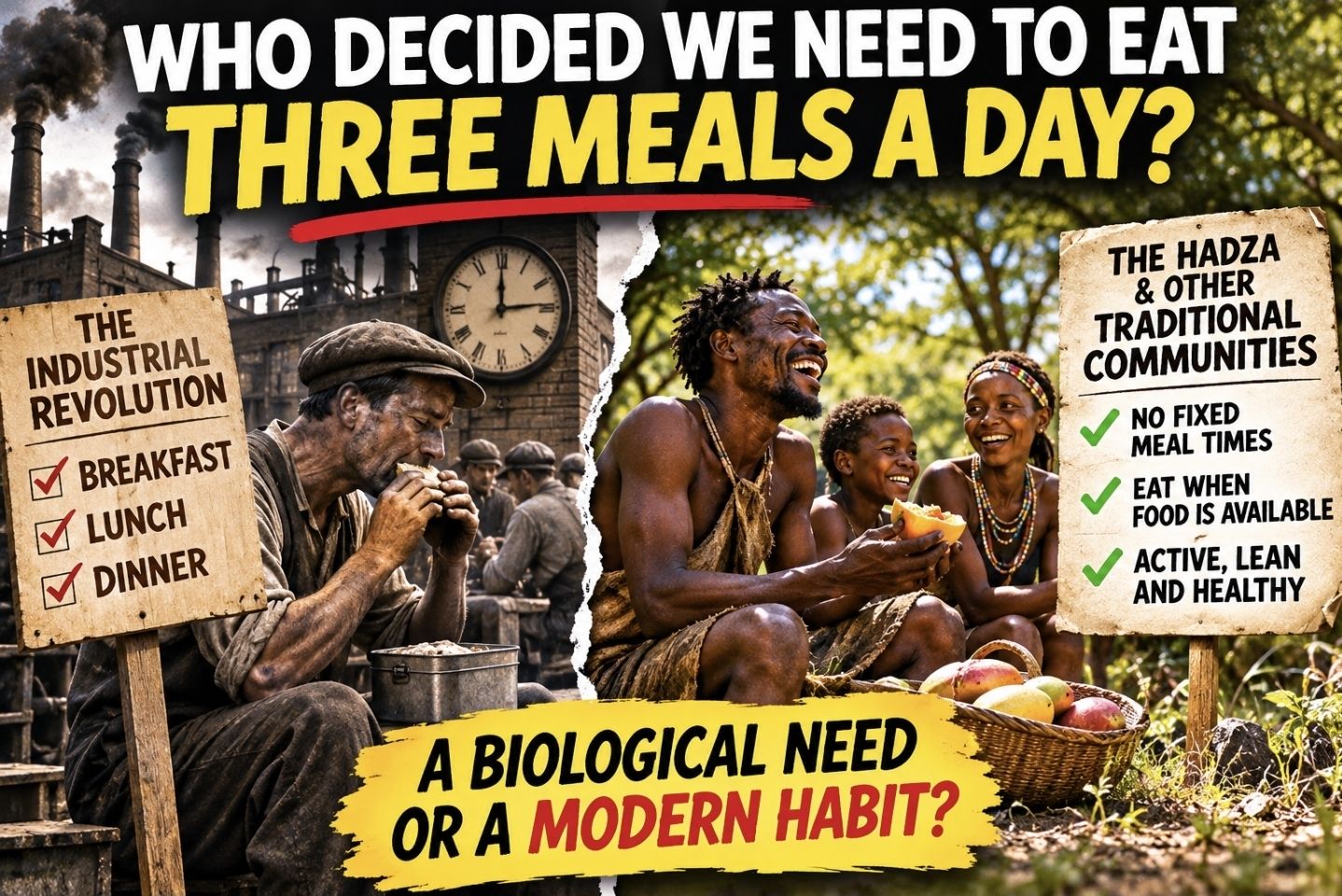
WHO DECIDED WE NEED TO EAT THREE MEALS A DAY? 🤔
And while we’re at it, who decided we need snacks between them?
Think about how most people eat.
Breakfast at 8. A snack at 11. Lunch at 1. Something sweet in the afternoon. Dinner at 7. Then perhaps a little something before bed.
Some people barely go two hours without putting something into their mouths.
And we’ve somehow convinced ourselves that this is perfectly normal.
But have you ever wondered where this routine came from?
Let’s go back to the Industrial Revolution.
Before factories, shift patterns and the modern working day, eating habits varied enormously.
People certainly ate regular meals long before industrialisation, but there wasn’t one universal timetable.
Then industrialisation changed how millions of people lived.
People moved into towns and cities. Factory bells dictated when work started, when workers could take a break and when they went home.
Breakfast before work. A meal during the working day. Another when you got home.
The three-meal pattern already existed, but industrialisation helped reinforce eating around fixed working hours.
And eventually, those routines became so familiar that we stopped questioning them.
But here’s where things get interesting.
Not everyone around the world follows our eating habits.
Take the Hadza people of Tanzania, one of the few remaining communities that still practise traditional hunting and gathering.
Their daily lives are very different from ours.
Food gathering, hunting, seasonal availability and sharing all influence when and what people eat.
They don’t organise their entire day around a factory-style breakfast, lunch and dinner timetable.
Researchers studying the Hadza have also observed that their physical activity and food environment differ considerably from those of industrialised populations.
And they’re not the only example.
Traditional hunter-gatherer communities, including the San peoples of southern Africa and some Indigenous communities in the Amazon, have historically followed eating patterns influenced by food availability, seasons and daily activity.
Of course, these communities are diverse. Their eating habits vary, and it would be misleading to suggest they all eat once a day or enjoy perfect health.
But they demonstrate something important.
Three meals a day is a cultural convention, not a biological requirement shared by every human society.
And that raises another question.
If humans can organise their eating in different ways, why are we so convinced that everyone needs breakfast, lunch and dinner at fixed times?
Does your stomach know it’s lunchtime?
Does your digestive system look at the clock and decide it needs feeding?
Of course not.
Yet millions of people eat at precisely the same times every day, whether they’re genuinely hungry or not.
And here’s something else worth considering.
When does your digestive system get a break?
Every time you eat, your body has work to do.
Food needs to be broken down, nutrients absorbed, blood sugar regulated and waste moved through the digestive tract.
Our digestive systems are designed to handle regular meals, but constantly grazing isn’t necessarily beneficial.
One thing I’ve noticed since changing my own eating habits is just how much of what we call hunger can actually be habit.
We eat because it’s lunchtime.
We eat because we’re bored.
We eat because someone offers us something.
We eat because there’s food in front of us.
And sometimes we eat because we’ve been told that skipping a meal is unhealthy.
Since when did the clock become more important than our appetite?
From a Natural Hygiene perspective, I believe we should pay much closer attention to genuine hunger and how our bodies respond to food.
That includes recognising when we’ve had enough.
Of course, hunger isn’t always a perfect guide. Stress, illness, medication and nutritional needs can all affect appetite, and some people genuinely need regular meals.
But I do think we’ve normalised eating far more frequently than many of us need.
And the food industry has been only too happy to encourage it.
Breakfast cereals. Breakfast bars. Protein snacks. Energy drinks. Meal replacements. Late-night treats.
There’s always another opportunity to eat, and another company ready to sell us something.
We’ve gone from organising our meals around factory working hours to organising our lives around food.
Perhaps it’s time we started questioning some of these habits.
I’m not suggesting everyone should skip breakfast, abandon regular meals or start fasting.
I’m suggesting something much simpler.
Before reaching for food, ask yourself whether you’re genuinely hungry or simply following a routine.
Because eating three meals a day isn’t a biological law.
It’s a convention that happens to suit the way much of society operates.
So here’s my question.
If you didn’t have a clock, a job telling you when to take lunch, or years of conditioning around mealtimes…
Would you still eat three meals a day?