
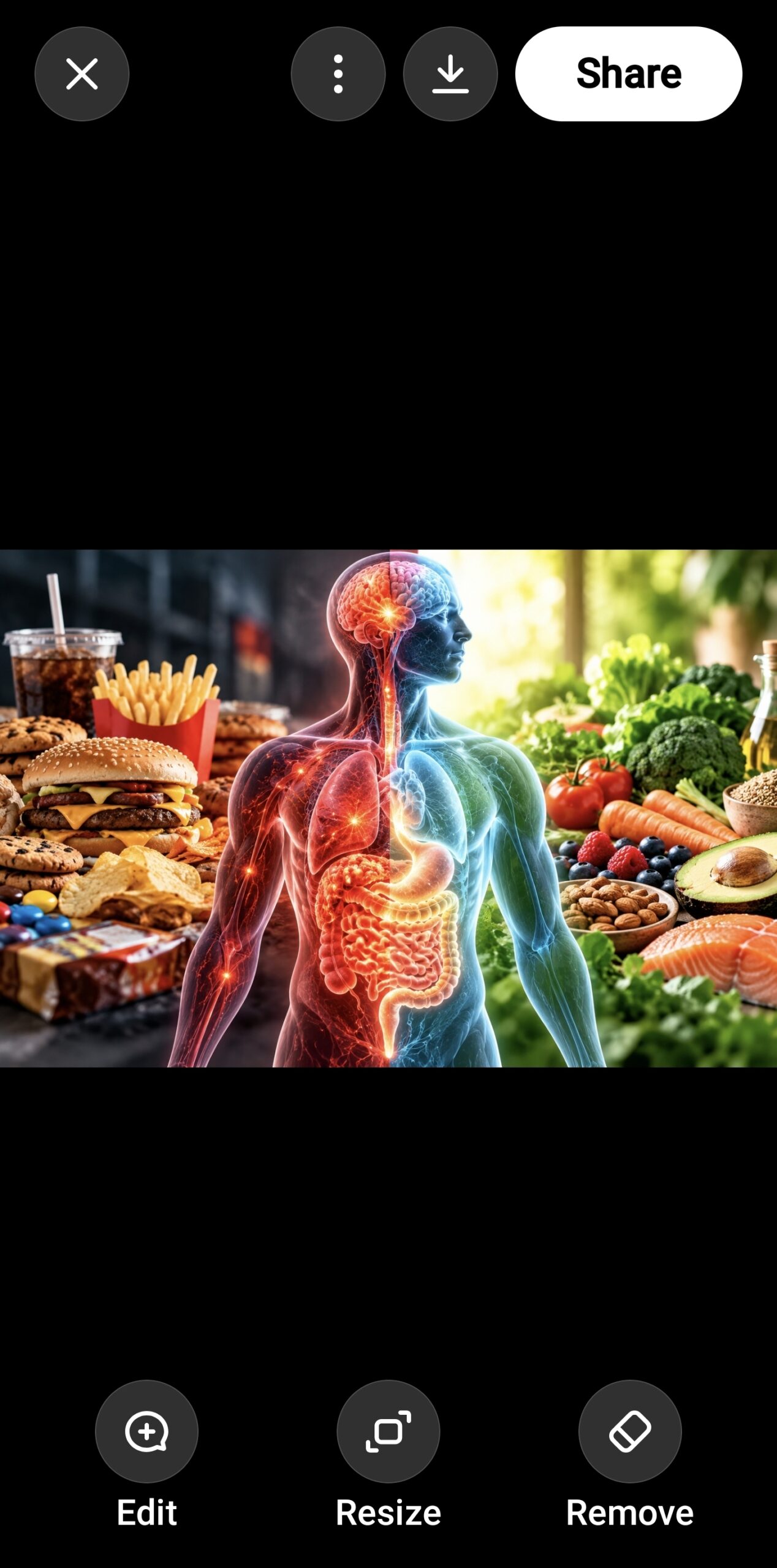
For years, nutrition has largely been reduced to numbers.
Calories. Protein. Fat. Carbohydrate. Sugar. Fibre.
But what if two meals containing almost the same amounts of these nutrients do not produce the same response inside the body?
New research published in Nature Metabolism on 5 October 2026 adds an important piece to that question. Researchers compared ultra-processed and non-ultra-processed meals that were closely matched nutritionally. Despite those similarities, the body and brain responded differently.
That raises a much bigger question:
Does the body respond only to the nutrients in food — or also to what we have done to the food?
What is ultra-processed food?
Not all processing is the same. Cutting an apple, freezing peas or blending fruit changes a food, but that is very different from industrial manufacturing that substantially restructures ingredients and combines them with substances not normally used in home cooking.
The NOVA classification describes ultra-processed foods as industrial formulations typically produced through multiple processing stages and often containing additives, flavourings, emulsifiers, modified starches or other manufactured ingredients.
Common examples can include many packaged snack foods, confectionery, soft drinks, some breakfast cereals, instant products, reconstituted meat products and ready meals.
The important point is that “processed” is not one single category of food. The degree and type of processing matter.
What did the new 2026 study find?
The new randomised crossover study involved 57 healthy-weight adults.
Participants consumed either an ultra-processed or non-ultra-processed meal. The meals were designed to be nutritionally similar, allowing researchers to investigate whether the degree of processing itself affected the response after eating.
It did.
Compared with the non-ultra-processed meal, the ultra-processed meal produced:
- a greater insulin response
- a greater energetic response after eating
- lower carbohydrate oxidation
- different patterns of brain activity associated with responses to food cues
The researchers concluded that food processing can influence metabolic and neural responses through mechanisms that go beyond calories and macronutrients alone.
Same calories does not necessarily mean the same response
This is perhaps the most interesting part of the research.
We often talk about food as though the body were a simple calorie-counting machine. Put a certain number of calories in and a predictable response comes out.
Human physiology is far more complicated.
The physical structure of food, how quickly nutrients become available, how rapidly it is eaten, how easily it can be digested and absorbed, its combination of ingredients and its effects after entering the digestive tract can all influence the response.
The latest experiment does not prove that every ultra-processed food causes the same effect. It tested particular meals in a relatively small group of healthy adults. But it demonstrates something important: nutritionally similar meals can produce measurably different physiological responses.
Ultra-processed food can also make us eat more
This is not the first controlled experiment to find an important difference.
In a well-known NIH inpatient randomised controlled trial, 20 adults spent two weeks eating an ultra-processed diet and two weeks eating an unprocessed diet.
The diets presented to participants were matched for calories, energy density, macronutrients, sugar, sodium and fibre, and participants were allowed to eat as much or as little as they wanted.
During the ultra-processed diet, people consumed approximately 500 additional calories per day on average.
They also ate faster and gained around 0.9 kg during the ultra-processed phase, while losing approximately the same amount during the unprocessed phase.
That does not mean calories cease to matter. Rather, it suggests that the form of the food may influence how much we spontaneously consume.
Why might processing change the body’s response?
There probably is not one single explanation.
Industrial processing can alter the physical structure of food. Cell walls may be broken down, starches altered, ingredients isolated and recombined, and foods made exceptionally soft or easy to consume quickly.
This can change how rapidly nutrients become available in the digestive system.
Ultra-processed foods can also contain combinations of refined carbohydrate, fat, salt, flavourings and textures that are uncommon in foods in their original state.
The 2026 researchers are careful not to claim that they have identified one culprit. They specifically note that further research is needed to separate the effects of individual processing methods, additives and food structures.
What about the brain?
The researchers also examined brain responses to food cues.
Differences in metabolism between the two meals were associated with differences in activity in brain regions involved in food valuation and reward.
This is particularly interesting because eating is not controlled simply by an intellectual calculation of how many calories we require.
Taste, texture, learned associations, metabolic feedback and reward all influence our desire to eat.
Scientists are now investigating whether the altered metabolic response produced by highly processed foods also changes the signals travelling between the digestive system and brain.
The Natural Hygiene perspective
Long before ultra-processed food became a scientific classification, Natural Hygiene placed enormous emphasis on eating foods close to their natural state.
The reasoning was simple: the human organism developed in an environment of recognisable foods, not industrial formulations assembled from fractions, isolates, flavourings and additives.
Natural Hygiene therefore asks a different question from conventional calorie counting.
Instead of asking only:
“How much protein, carbohydrate, fat and how many calories does this contain?”
it also asks:
“Is this a food the body is naturally adapted to dealing with?”
The new research does not prove Natural Hygiene theory. But it does support the broader idea that looking only at calories and macronutrients can miss important differences in how foods interact with human physiology.
Does this mean every packaged food is unhealthy?
No.
Packaging and processing are not synonymous with ultra-processing.
Frozen fruit, frozen vegetables, chopped vegetables and many simple packaged foods can remain very close to their original state.
The useful distinction is not “packet versus no packet”.
Ask how far the product has travelled from the original food.
Can you still recognise what it is? Is the ingredient list essentially food, or has the product been reconstructed from refined ingredients and additives?
What happens when you stop eating processed food?
Reducing ultra-processed foods often changes far more than one ingredient. It can simultaneously change food density, eating speed, fibre structure, water content, palatability and the amount of refined ingredients being consumed.
We explore that side of the subject separately in What Happens to the Body When You Stop Eating Processed Food?
That article looks at what people may notice after moving away from processed foods, while this page focuses on what the research tells us about what happens after ultra-processed food enters the body.
Is the problem just sugar and fat?
Probably not.
Sugar, fat, salt and overall energy intake clearly matter. But controlled feeding research is increasingly allowing scientists to compare foods while holding many of these variables relatively constant.
The fact that differences can remain when nutrients are closely matched suggests that food structure and processing deserve attention in their own right.
That is an important shift.
Food is more than a nutrition label
A nutrition label can tell you useful things.
But it cannot completely describe a food.
It cannot show the original cellular structure of the ingredients, how aggressively they were processed, how quickly the finished product will be eaten or exactly how the body will respond once it reaches the digestive tract.
Two foods can therefore look remarkably similar on paper while behaving differently inside a living human being.
And perhaps that is the larger lesson.
The body does not eat nutrition labels. It has to deal with the actual food.
Frequently asked questions
What counts as ultra-processed food?
Ultra-processed foods are generally industrial formulations made using substantial processing and ingredients or additives not commonly used in ordinary home cooking. The NOVA classification is the system most commonly used in research to define them.
Do ultra-processed foods make you eat more?
They can. In a tightly controlled NIH study, participants ate around 500 more calories per day when offered an ultra-processed diet compared with an unprocessed diet, despite the diets being designed to match several major nutritional characteristics.
Are ultra-processed foods bad even if the calories are the same?
A new 2026 controlled study found different metabolic and neural responses after nutritionally similar ultra-processed and non-ultra-processed meals. This does not mean all ultra-processed foods have identical effects, but it shows that calorie and macronutrient content do not necessarily tell the whole story.
Is processed food the same as ultra-processed food?
No. Almost all food undergoes some processing. Washing, chopping, freezing or cooking is very different from industrial ultra-processing. The terms should not be used interchangeably.
What is the simplest way to reduce ultra-processed food?
Base more meals around recognisable whole or minimally processed foods and gradually replace products built primarily from refined ingredients, flavourings and additives. The aim does not need to be perfection; shifting the overall balance of the diet can substantially reduce ultra-processed food intake.
A note on the research: Nutrition science continues to investigate why ultra-processed foods produce the effects seen in controlled and observational studies. The latest research strengthens the evidence that processing itself can influence physiological responses, but it does not establish that every processing method, additive or ultra-processed product has the same effect.