Your body emits light. So do fruits, vegetables and other living tissues. These ultra-weak emissions are known as biophotons — and unlike many of the extraordinary claims made about them online, their existence can actually be measured.
But what are biophotons? Do fresh foods emit more of them? Does cooking change them? And could the faint light produced by our own cells tell researchers something about metabolism, oxidative activity and health?
This article separates what biophoton research has genuinely demonstrated from what remains hypothesis. It also explores why the subject is particularly interesting when viewed alongside Natural Hygiene, fresh raw foods, the Law of Vital Economy and the wider functioning of the body’s systems.
Watch: The Cellular System
This Natural Body Intelligence video gives useful context for understanding the cellular system before exploring ultra-weak photon emissions, cellular activity and the wider relationship between fresh food, light and living tissues.
🔬 What Are Biophotons?
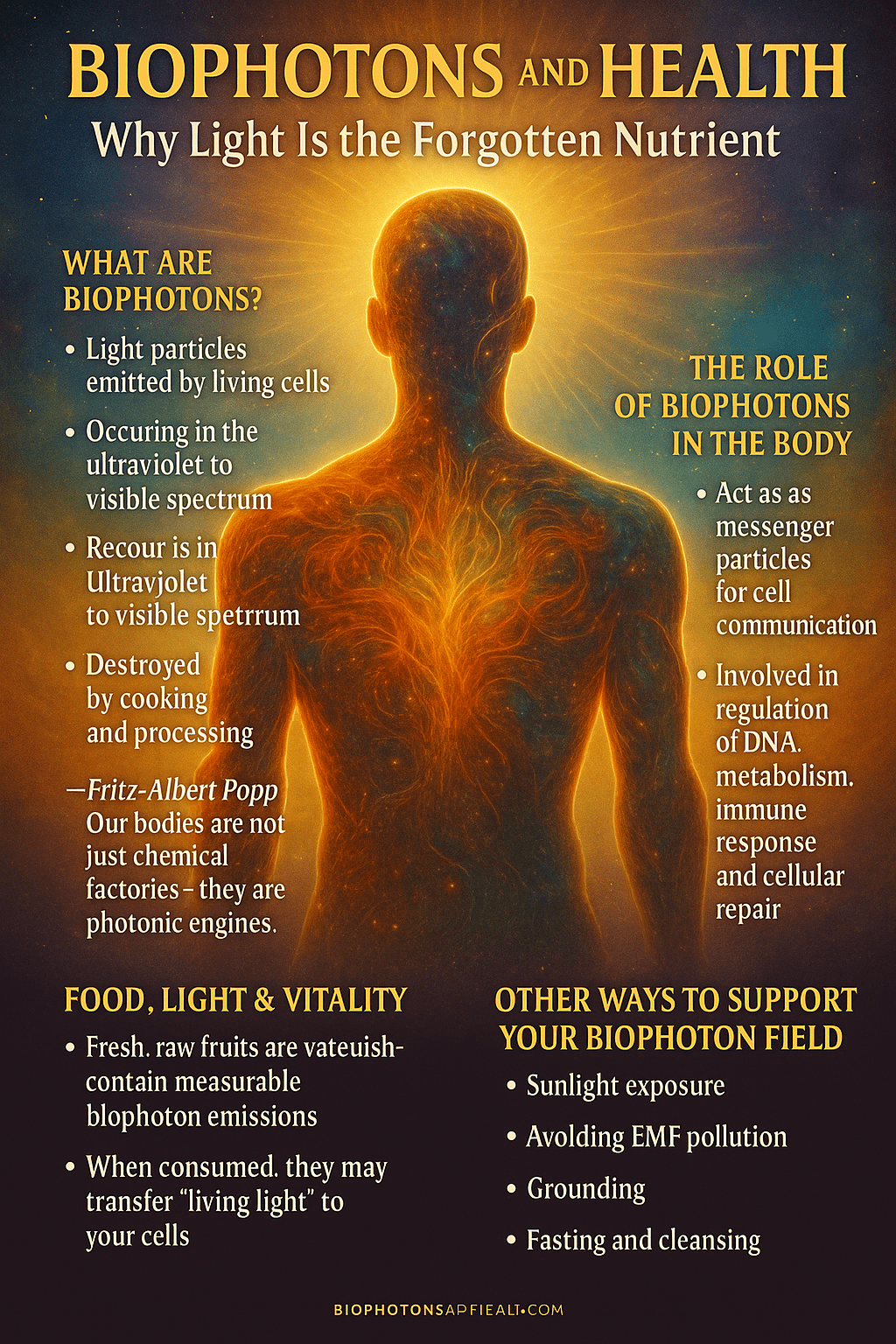
Biophotons are light particles emitted by living cells. First discovered by Russian scientist Alexander Gurwitsch in the 1920s, and later rigorously studied by Fritz-Albert Popp, these light emissions occur in the ultraviolet to visible spectrum and are not produced by heat (non-thermal).
The intensity is measured at about 10⁻¹⁹ to 10⁻¹⁶ watts per square centimetre, and their presence is constant—and meaningful.
“All living systems emit light… and the coherence of that light is a measure of the system’s order, its health, its vitality.”
— Fritz-Albert Popp, PhD
📡 What Might Biophotons Tell Us About the Body?
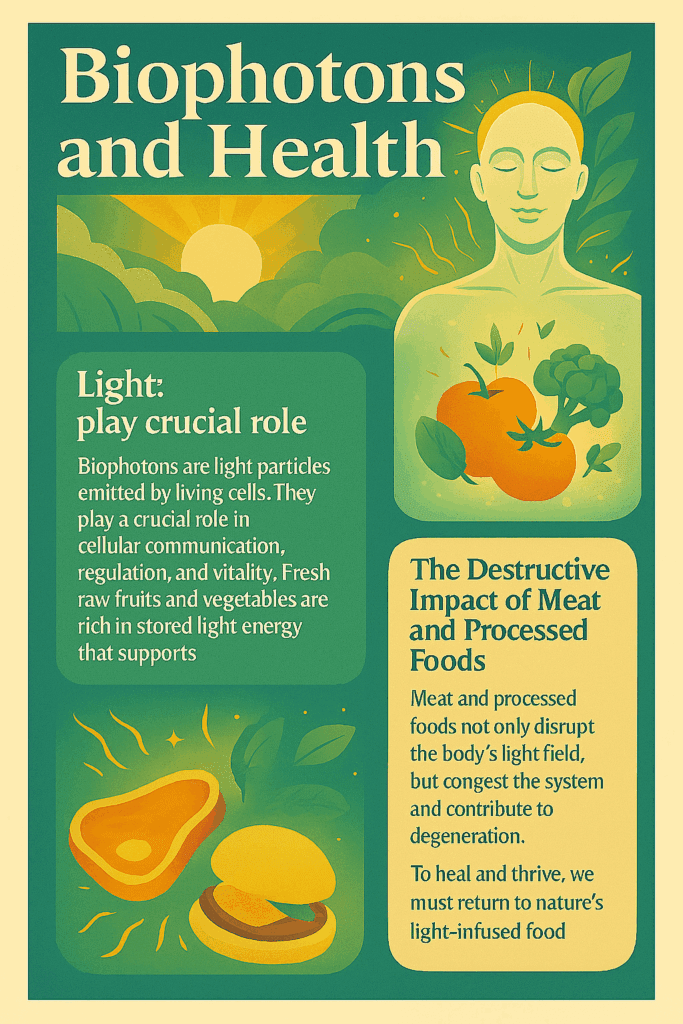
Ultra-weak photon emission is a real and measurable phenomenon in living tissues. Research indicates that much of this light is associated with oxidative and metabolic reactions occurring within cells.
Researchers are investigating whether changes in these emissions could provide useful information about physiological activity, oxidative stress and the condition of biological tissue. The possibility that ultra-weak light may also participate in some forms of cellular signalling has been explored, but this is not yet established as a general communication system in the human body.
It is therefore more accurate to view biophotons as a fascinating measurable feature of living systems rather than as a proven measure of health, vitality or a hidden “light communication network”.
For the human evidence specifically, read Do Humans Really Emit Light? The Science of Biophotons.
Biophotons in Food
Living plant tissues emit ultra-weak photons, and this emission can be measured in fruits, vegetables, leaves, seeds and other biological material. The intensity and pattern of these emissions can vary according to factors such as the plant species, freshness, growing conditions, storage, physical damage and oxidative activity within the tissues.
This is where the subject becomes particularly interesting from a Natural Body Intelligence perspective.
Fresh fruits and vegetables have spent their lives interacting directly with sunlight. Through photosynthesis, plants capture light energy and convert it into chemical energy, which is then stored within their tissues. Ultra-weak photon emissions from those living tissues are one measurable consequence of the biochemical activity taking place within them.
This does not mean that biophotons should be treated as another vitamin or nutrient with a daily recommended intake. Science has not established that eating foods with greater photon emission directly transfers a measurable quantity of beneficial “light energy” into human cells.
What we can say is that fresh plant foods are biologically active tissues and that ultra-weak photon emission is one way researchers can observe aspects of that activity.
From the Natural Hygiene perspective, this adds another fascinating dimension to the value of fresh, minimally processed food. Fruits and vegetables also provide water, carbohydrate, fibre, vitamins, minerals and thousands of naturally occurring plant compounds within a food structure produced by nature rather than a factory.
This wider emphasis on natural foods forms part of the principles of Natural Hygiene and the way Natural Body Intelligence looks at nourishment as part of the body’s overall environment.
Which Foods Are Rich in Biophotons?
nnnnFor a dedicated answer to this question, see What Foods Have the Most Biophotons?.
nnnThe phrase “biophoton-rich foods” is often used in natural-health circles to describe fresh, living plant foods that show measurable ultra-weak photon emission.
There is not yet a scientifically established table ranking foods by their “biophoton content” in the way foods can be ranked for vitamin C, potassium or protein. Photon emission from biological tissue varies with freshness, plant type, growing conditions, storage, temperature, oxidation and even how the food has been handled.
For that reason, it is more useful to think in terms of broad categories rather than claiming that one particular fruit contains a precise amount of biophoton energy.
Fresh plant foods are the most relevant foods to explore, including:
- Fresh fruit, particularly fruit that has been recently harvested.
- Leafy green vegetables and other fresh vegetables.
- Fresh herbs and young plant shoots.
- Sprouted seeds and seedlings, which are undergoing rapid biological activity.
- Freshly harvested produce that has undergone minimal storage and processing.
From the Natural Body Intelligence perspective, the attraction of these foods extends far beyond photon emission. Fresh fruits and vegetables provide water, fibre, carbohydrates, minerals, vitamins and a wide range of naturally occurring plant compounds while remaining close to their original biological form.
This is one reason NBI places such emphasis on the benefits of raw foods rather than viewing nutrition purely as a collection of isolated nutrients.
Freshness may also matter. A fruit picked from a tree and eaten shortly afterwards is biologically different from one harvested weeks earlier, transported long distances, stored under controlled conditions and eventually eaten after prolonged storage.
That does not mean older produce suddenly becomes worthless. It simply illustrates that food is dynamic biological material rather than an inert package of calories.
The broader Natural Body Intelligence approach is therefore not to chase the food supposedly containing the “most biophotons”, but to favour a varied diet built around fresh, whole, minimally processed plant foods wherever practical.
This principle also connects with the Law of Vital Economy — the Natural Hygiene idea that the conditions we create can influence how much demand we place upon the body’s available resources.
Does Cooking Reduce Biophotons?
nnnnWe explore this question in more depth in Does Cooking Destroy Biophotons in Food?.
nnnIt is often claimed that cooking “destroys biophotons”, but that statement is too simple.
Ultra-weak photon emission comes from biochemical reactions occurring within biological tissues. Heating food changes those tissues substantially. Enzymes are altered, cell membranes break down, oxidation patterns change and the food is no longer functioning as living plant tissue in the same way it was before heating.
Because of this, the pattern and intensity of ultra-weak photon emission can change after cooking, storage, cutting, bruising and other forms of processing.
That does not, however, mean that science has established a simple rule that raw food contains a fixed amount of beneficial light which is then completely destroyed by heat.
From a Natural Body Intelligence perspective, there are broader reasons for favouring a high proportion of fresh, uncooked plant foods. Raw fruits and vegetables naturally contain water, fibre and many heat-sensitive plant compounds within their original food structure, and they generally require little industrial processing before being eaten.
At the same time, cooking is not automatically synonymous with unhealthy food. Different foods respond differently to heating, and in some cases cooking can make particular nutrients more available.
The more useful principle is therefore not:
“Cooked food contains no life or value.”
It is:
“The further food moves from its fresh, whole biological state, the more its original structure and chemistry are changed.”
This is part of the wider NBI distinction between fresh whole foods and heavily processed foods, explored further in The Best Benefits of Raw Foods and Inferior Foods: What They Do to the Body and Why It Matters.
For someone interested specifically in biophotons, freshness, storage and processing are therefore just as important to consider as whether a food is technically raw or cooked.
How Can You Increase Biophotons Naturally?
nnnnFor the practical evidence-based answer, see Can You Increase Biophotons in Your Body Naturally?.
nnnPeople searching for ways to increase biophotons naturally are usually asking how they can increase their exposure to fresh, biologically active foods and support the body’s own cellular processes.
It is important to clarify that biophotons are not a nutrient that can simply be “topped up” in the way we might increase vitamin C or iron. Human cells themselves produce ultra-weak photon emissions as a consequence of normal biochemical reactions, particularly reactions involving oxidation and cellular metabolism.
We therefore cannot currently say that eating a particular food directly raises a person’s internal “biophoton level”.
What we can do is create conditions that support normal cellular function while choosing foods that remain close to their fresh biological state.
From a Natural Body Intelligence perspective, practical ways of doing this include choosing freshly harvested fruits and vegetables where possible, eating a varied range of whole plant foods, reducing reliance on heavily processed products, spending regular time outdoors in natural daylight, allowing adequate rest and sleep, remaining physically active and reducing unnecessary physiological burden.
Freshness is particularly interesting. Produce continues to undergo biological and chemical changes after harvesting, so a freshly picked piece of fruit is not identical to one that has spent weeks in transport and storage.
That does not mean everybody needs to grow their own food. Rather, it reinforces a broader principle: choose fresh, whole and minimally processed foods whenever reasonably possible.
NBI explores this principle throughout our material on Natural Hygiene and the body’s systems, because nourishment is only one part of the environment in which the body’s cells operate.
Sleep, movement, sunlight, rest, emotional stress, environmental exposures and the demands placed upon digestion all form part of the bigger picture.
Rather than asking, “How many biophotons can I consume?”, a more useful question may therefore be:
“What conditions best support the normal functioning of living cells?”
That question sits at the heart of the Natural Body Intelligence approach.
The Role of Biophotons in the Body
Photon emissions have been detected from many types of living cells and tissues, including human tissue. They appear to arise largely from chemical reactions associated with cellular metabolism and oxidative processes.
Researchers have been interested in whether these emissions might tell us something about what is happening inside living cells. Studies have explored possible relationships between photon emission and oxidative stress, metabolism, cell growth, communication between biological systems and changes occurring within damaged or diseased tissue.
There are also hypotheses that ultra-weak light may play some role in biological signalling. This remains an active area of research rather than an established mechanism of human cellular communication.
DNA, proteins, cell membranes, mitochondria and many other structures continually interact through highly organised biochemical and electrical processes. Whether ultra-weak photon emission is simply a consequence of these processes or also contributes to their regulation remains an intriguing scientific question.
From a Natural Body Intelligence perspective, the subject is fascinating because it provides another reminder that the body is not simply a collection of isolated organs. It is an extraordinarily coordinated living system in which trillions of cells are continually responding to one another and to their environment.
You can explore that wider coordination through our guide to the body’s systems.
Research into biophotons therefore does not prove that the body possesses a separate “light communication system”, but it does reveal that living tissues produce measurable ultra-weak light as part of their biological activity — and there is still much to learn about what those emissions may tell us.
Fresh Whole Foods and Heavily Processed Foods
The Natural Body Intelligence approach places particular emphasis on fresh, whole plant foods and minimising foods that have been extensively refined, preserved or industrially processed.
From a biophoton perspective, however, we need to be careful about claims that particular foods contain “no light”. Ultra-weak photon emission is associated with biochemical and oxidative reactions in biological material, and it cannot simply be divided into “living foods that contain light” and “dead foods that contain none”.
The more useful distinction is what happens to food as it moves further away from its original biological state.
Fresh fruits and vegetables remain complex plant tissues containing water, fibre, carbohydrates, vitamins, minerals and thousands of naturally occurring plant compounds. Storage, heating, refining and industrial processing can alter that structure and chemistry to varying degrees.
Highly processed foods may also contain large amounts of refined sugar, refined fats, salt, additives and ingredients that would rarely occur together in that concentration in whole foods. This can make them very different nutritionally from the plants from which some of their ingredients originated.
Natural Body Intelligence therefore favours food that remains recognisable and close to its natural form — particularly fresh fruits, vegetables and other minimally processed plant foods.
You can explore this distinction further in Inferior Foods: What They Do to the Body and Why It Matters and our guide to the digestive system.
This does not require us to claim that one type of food literally “switches off” the body’s light. The stronger argument is much simpler: the form, freshness and degree of processing of our food changes what we are asking the body to handle.
That principle stands whether or not future research establishes a direct nutritional role for biophoton emission.
What About Meat and Animal Foods?
Biophoton discussions sometimes make the claim that meat contains no biophotons because the animal is no longer alive.
That is too simplistic.
Ultra-weak photon emission is associated with biochemical reactions, oxidation and metabolic activity in biological material. It is therefore more accurate to say that the photon-emission profile of tissue changes after death, storage, processing and cooking rather than claiming that all light simply disappears at one moment.
From a Natural Body Intelligence perspective, the argument for favouring fresh plant foods does not depend on proving that meat contains “no light”.
Fresh fruits and vegetables provide water, fibre, carbohydrate, vitamins, minerals and naturally occurring plant compounds within their original biological structure.
Animal foods are very different in composition and place different demands upon digestion and metabolism.
NBI therefore favours fresh, whole plant foods for broader physiological reasons rather than relying on the claim that one food contains light while another contains none.
You can explore that wider distinction in Inferior Foods: What They Do to the Body and Why It Matters.
Food, Sunlight and Biological Energy
There is a genuine and fascinating relationship between food and sunlight.
Plants capture light energy through photosynthesis and convert it into chemical energy.
That energy becomes stored within carbohydrates and other organic molecules produced by the plant.
When humans eat plant foods, the usable energy we obtain comes primarily from this stored chemical energy rather than from directly absorbing visible photons into our cells.
Biophoton research adds another layer to this picture because living plant tissues also produce measurable ultra-weak photon emissions as part of their biological activity.
Research has shown that these emissions can change with plant stress, growth, ageing, storage and physiological condition.
This means that photon emission may provide researchers with information about the biological state of plant tissue.
It does not currently mean that scientists can assign a meaningful “light nutrition value” to a banana, lettuce leaf or apple.
Why Freshness Is Interesting
Freshness appears repeatedly in biophoton research because biological tissue continues changing after harvesting.
Fruit does not become chemically frozen in time the moment it leaves the plant.
Respiration continues.
Enzymatic activity continues.
Oxidation continues.
Water content changes.
Cell membranes change.
Energy metabolism changes.
Studies of fruit and seeds have shown that ultra-weak photon emission can change alongside ageing, storage and physiological condition.
This makes freshness scientifically interesting even without claiming that freshly picked fruit contains a mystical quantity of life-force.
From a Natural Body Intelligence perspective, it supports a much simpler principle:
Food is dynamic biological material, and the less it has been altered, stored and processed, the closer it remains to its original state.
Are Raw Foods Higher in Biophotons?
Fresh raw plant foods are living or recently living tissues and can produce measurable ultra-weak photon emissions.
Heating changes biological tissue substantially.
Cell membranes rupture, enzymes are altered, proteins change structure and metabolic activity within the plant tissue stops.
So it is reasonable to expect the photon-emission pattern of cooked food to differ from that of the same food when fresh and raw.
What has not been established is a universal scale showing that raw food contains a fixed amount of beneficial light which is then destroyed in direct proportion to cooking temperature.
This distinction matters.
We do not need to exaggerate biophoton science to make the case for fresh food.
Raw fruits and vegetables already have many well-understood characteristics that make them valuable foods: high water content, fibre, naturally occurring carbohydrate, vitamins, minerals and a wide range of plant compounds.
You can explore the wider NBI perspective in The Best Benefits of Raw Foods.
Do Humans Produce Biophotons?
Yes.
Human tissues produce measurable ultra-weak photon emissions.
These emissions are far too weak to see with the naked eye and require sensitive instruments such as photomultiplier tubes and specialised cameras.
Research indicates that much of this emission is related to normal oxidative and metabolic reactions occurring within cells.
Human photon emission also varies according to location on the body, time of day and physiological state.
Researchers are investigating whether these emissions could eventually provide useful information about metabolism, oxidative stress and changes in biological systems.
That is a far more interesting scientific story than simply saying that humans “glow”.
Do Biophotons Allow Cells to Communicate?
This remains one of the most intriguing questions in the field.
Experiments have investigated whether ultra-weak light could influence nearby cells even when chemical contact is prevented.
Some experimental work has produced results consistent with the possibility of non-chemical signalling through light.
However, this is not yet an established general mechanism of human cellular communication.
Cells already communicate through many well-understood systems including hormones, neurotransmitters, electrical activity, ions, receptors and chemical signalling pathways.
Biophoton signalling remains an area of active research.
That distinction makes the subject more credible, not less fascinating.
What Can Biophotons Tell Us About Health?
Researchers have investigated whether ultra-weak photon emission can provide information about physiological activity and oxidative processes.
Because reactive oxygen species and other metabolic reactions can generate photon emission, changes in UPE may reflect changes occurring within living tissue.
This has led researchers to explore potential applications in areas such as:
- oxidative stress
- metabolic activity
- plant stress and crop health
- food quality
- tissue changes
- non-invasive physiological monitoring
At present, biophoton measurement is mainly a research tool rather than a routine clinical test.
But the field demonstrates something important:
Living organisms produce measurable light as part of their normal biological activity.
How Can You Support Healthy Cellular Function?
If your interest in biophotons comes from wanting to improve health, the most useful approach is not trying to chase an invisible photon score.
Instead, focus on the conditions that support normal cellular function.
From a Natural Body Intelligence perspective, these include:
- fresh, whole plant foods
- adequate sleep
- regular natural daylight
- physical movement according to capacity
- fresh air
- adequate hydration
- periods of genuine rest
- reducing unnecessary physiological and emotional stress
- reducing reliance on heavily processed foods and stimulants
These principles matter whether or not future research eventually establishes a larger biological role for ultra-weak photon signalling.
They also connect closely with the Law of Vital Economy, which explores how the body continually allocates its available resources according to current demands.
Biophotons and the Natural Hygiene Perspective
Natural Hygiene has always encouraged us to look at the body as a whole living organism rather than a collection of isolated parts.
Biophoton research fits naturally into that broader curiosity.
Cells are constantly exchanging chemical, electrical and mechanical information.
They also produce ultra-weak light.
Whether that light is primarily a by-product of metabolism, a useful indicator of biological activity, part of a signalling system, or some combination of these remains under investigation.
The important point is that life is extraordinarily dynamic.
Food, sleep, light, movement, stress, temperature, metabolism and environment continually influence what is happening inside the body.
That is why Natural Body Intelligence focuses on creating favourable conditions rather than searching for one isolated substance or mechanism that explains health.
Frequently Asked Questions About Biophotons
Are biophotons real?
Yes. Ultra-weak photon emission from living cells and tissues has been measured experimentally for decades. The phenomenon is well established, although its full biological significance is still being investigated.
What foods contain the most biophotons?
There is no scientifically accepted ranking of foods by biophoton content. Fresh plant tissues such as fruits, vegetables, sprouts and seedlings produce measurable ultra-weak photon emissions, but the intensity can change with species, freshness, storage, stress and handling.
Does cooking destroy biophotons?
Cooking changes biological tissue and therefore changes its photon-emission characteristics. It is not accurate to say that every raw food contains a fixed amount of beneficial light which is simply destroyed by cooking.
Can eating biophoton-rich foods increase biophotons in the body?
There is currently no established evidence showing that eating a food with higher photon emission directly raises a person’s internal biophoton level.
How can I increase biophotons naturally?
Biophotons are not a nutrient that can simply be topped up. A more useful goal is supporting normal cellular metabolism through fresh food, sleep, movement, natural daylight, hydration, rest and a generally supportive lifestyle.
Can biophotons be seen?
No. Human ultra-weak photon emission is far below the threshold of normal human vision and requires highly sensitive equipment to detect.
Do biophotons prove that the body is made of light?
Living tissues do emit measurable photons, but that does not mean the body is literally powered by light in the same way a plant uses sunlight during photosynthesis. Human metabolism relies primarily on chemical energy derived from food.
Scientific Research on Biophotons
For readers who want to explore the scientific literature directly, these are useful starting points:
- Mould RR, Mackenzie AM, Kalampouka I, et al. (2024). Ultra weak photon emission — a brief review. Read the review.
- Ives JA, van Wijk EPA, Bat N, et al. (2014). Ultraweak Photon Emission as a Non-Invasive Health Assessment: A Systematic Review. Read the systematic review.
- Fels D. (2009). Cellular communication through light. View on PubMed.
- Calcerrada M, Garcia-Ruiz C. (2019). Human Ultraweak Photon Emission: Key Analytical Aspects, Results and Future Trends. View on PubMed.
- Van Wijk R, Van Wijk EPA, van Wietmarschen H, van der Greef J. (2014). Towards whole-body ultra-weak photon counting and imaging with a focus on human beings. View on PubMed.
Final Thought
Biophotons reveal something genuinely extraordinary about living systems:
life produces light.
That statement is scientifically measurable.
What that light ultimately means biologically is still being explored.
That is what makes the subject so interesting.
We do not need to turn biophotons into a mystical nutrient or claim that every photon has a known healing purpose.
The evidence already shows that photon emission reflects real activity taking place inside living cells and tissues.
And the more science learns about those processes, the more we may understand about how extraordinarily coordinated living systems really are.
Explore the Biophotons Series
Biophotons raise several fascinating questions. Explore each one in more detail:
- Do Humans Really Emit Light? The Science of Biophotons
- What Foods Have the Most Biophotons?
- Does Cooking Destroy Biophotons in Food?
- Can You Increase Biophotons in Your Body Naturally?
Explore Natural Body Intelligence Further
Biophotons are only one small part of the much bigger picture of how living systems function.
Natural Body Intelligence explores health through food, rest, movement, sunlight, sleep, environment, emotional wellbeing and the body’s own regulatory processes.