
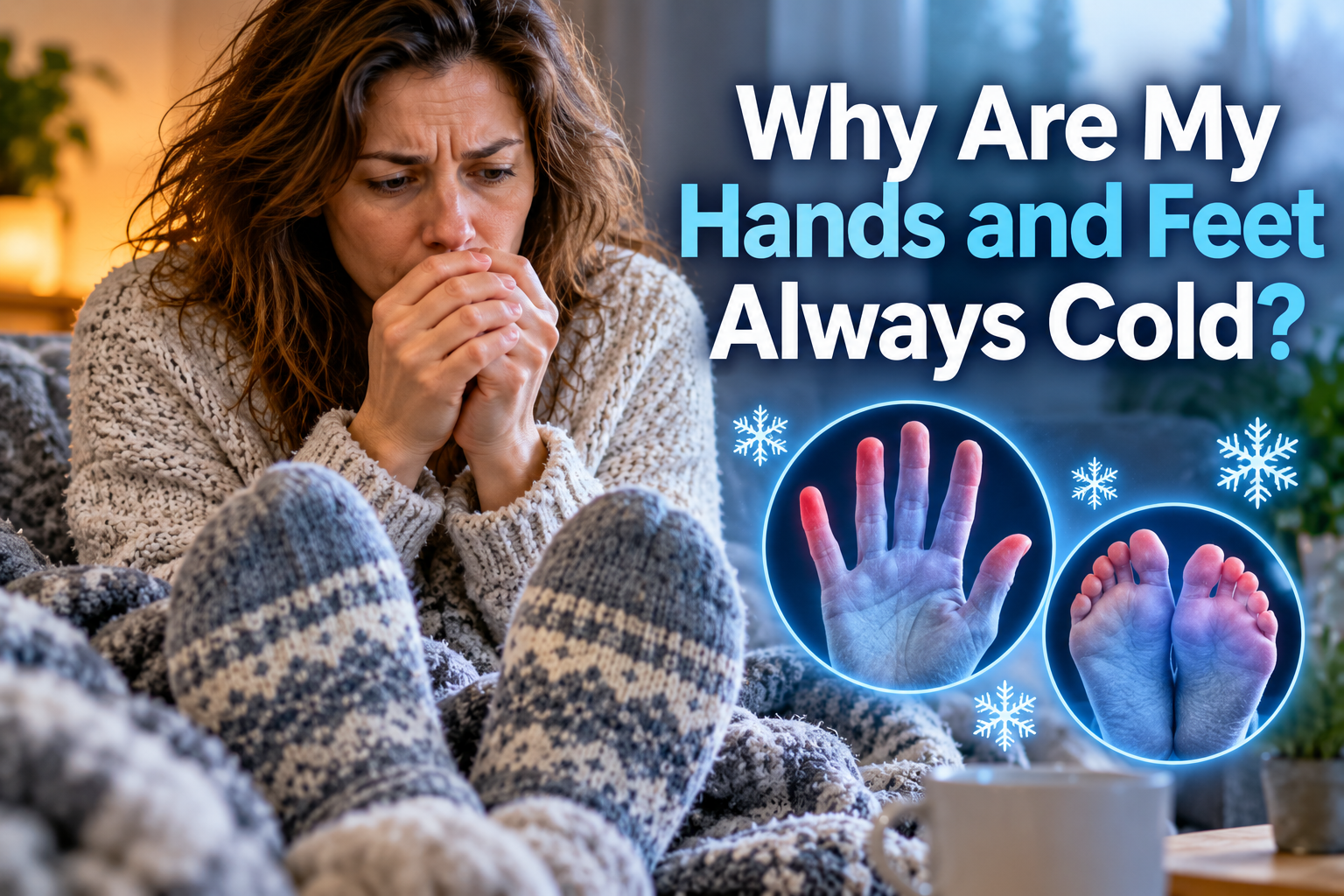
Everyone else in the room seems perfectly comfortable.
Meanwhile, your hands feel like ice.
Your feet are cold even though you’re wearing socks, and getting into bed sometimes means waiting for your toes to warm up before you can relax.
If this happens regularly, you might wonder:
Why are my hands and feet always cold when the rest of me feels fine?
Often, the explanation comes down to something quite simple: your body regulates blood flow differently in your extremities than it does in your core.
But persistently cold hands and feet can also be associated with Raynaud’s phenomenon, thyroid problems, anaemia and other conditions.
So let’s look at what’s actually happening.
Your body doesn’t distribute heat equally
Your body is constantly regulating its internal temperature.
When you’re exposed to cold, blood vessels near the surface of the skin narrow. This is called vasoconstriction.
It reduces the amount of warm blood reaching the skin and helps conserve heat around important internal organs.
Your fingers and toes are particularly noticeable because they’re a long way from your core and have a relatively large surface area compared with their volume.
That’s why your hands and feet can become cold long before the rest of you feels particularly chilly.
For some people, this response is simply much stronger than it is for others.
Why do some people feel the cold more?
There isn’t one universal reason.
Your response to temperature can be influenced by factors including:
- the temperature around you
- body size and composition
- physical activity
- circulation
- hormones
- metabolic rate
- stress
- smoking
- medications
- underlying health conditions
Even your emotional state can temporarily affect blood flow to the hands.
So cold fingers aren’t automatically evidence that something is wrong.
The important questions are how often it happens, how severe it is, whether anything else changes and whether you have other symptoms alongside it.
What is Raynaud’s?
One condition particularly associated with cold fingers and toes is Raynaud’s phenomenon.
With Raynaud’s, the small blood vessels supplying the extremities respond excessively to cold or emotional stress.
The fingers may change colour. They can become pale or white, sometimes blue, and then red as circulation returns.
You may also experience numbness, tingling, throbbing, pain or difficulty warming your fingers or toes.
Some people have primary Raynaud’s, where there is no obvious underlying disease. Secondary Raynaud’s can occur alongside another medical condition.
If your fingers or toes repeatedly change colour, become painful or develop sores, it deserves proper medical assessment rather than simply being dismissed as poor circulation.
Could it be your thyroid?
Possibly.
Thyroid hormones influence metabolism throughout the body, and an underactive thyroid can make some people unusually sensitive to cold.
Cold intolerance alone doesn’t mean you have hypothyroidism. Other possible symptoms include tiredness, constipation, dry skin, changes in weight, low mood and slower thinking.
If several of these are happening together, thyroid testing may be appropriate.
We’ve covered this in more detail in our guide: Can an Underactive Thyroid Ever Return to Normal?
The important point is not to diagnose thyroid problems from cold hands alone. A blood test provides far more useful information than symptoms by themselves.
What about anaemia and iron deficiency?
Iron deficiency is another possibility worth understanding.
Iron is required to produce haemoglobin, the protein in red blood cells that carries oxygen around the body.
When iron deficiency progresses sufficiently to cause anaemia, symptoms can include tiredness, weakness, breathlessness, paleness, dizziness and feeling cold.
Vitamin B12 or folate deficiency can also cause certain types of anaemia.
Again, cold hands aren’t enough to diagnose any of these.
But if you’re persistently cold and unusually tired, breathless or weak, it may be worth discussing blood tests with a healthcare professional.
Is it simply “poor circulation”?
People use the phrase poor circulation very loosely.
Cold hands don’t necessarily mean that your cardiovascular system is failing to circulate blood properly.
Often the blood vessels are doing precisely what they’re designed to do: changing their diameter to regulate heat.
However, vascular disease can reduce blood supply to parts of the body, particularly the legs and feet.
Signs that deserve investigation include pain in the legs when walking, wounds that heal poorly, significant colour changes, one foot being noticeably colder than the other or persistent numbness.
Stress can make your hands cold
Have you ever noticed your hands becoming cold when you’re nervous?
There is a physiological reason.
The autonomic nervous system helps regulate blood-vessel diameter. During stress, blood flow patterns can change as part of the body’s wider response.
That means somebody can be sitting in a warm room and still develop cold or clammy hands during anxiety, excitement or emotional stress.
Movement makes a difference
Muscles generate heat. They also help support blood flow through movement.
If you’ve been sitting at a desk for several hours, it’s hardly surprising if your feet feel colder than they do after a brisk walk.
Before assuming something complicated is wrong, notice what happens when you move.
Stand up. Walk around. Move your fingers and toes. Go outside for a walk.
If your hands and feet warm relatively quickly, inactivity may simply be contributing to the problem.
Smoking and nicotine can make matters worse
Nicotine constricts blood vessels.
This can reduce blood flow to the skin and extremities.
For somebody already prone to cold fingers or Raynaud’s attacks, nicotine can make the problem worse.
This includes nicotine from sources other than cigarettes.
What if my hands and feet become cold when fasting?
That’s a slightly different situation.
When you’re fasting, you’re no longer generating the same amount of heat through digestion, your metabolism is adapting to the absence of incoming food, and you may also be moving less.
Cold hands and feet are therefore commonly reported during fasting.
We’ve covered that separately in Why Do I Feel Cold When Fasting?
If the coldness only occurs during fasting, that context is obviously very different from feeling freezing cold every day while eating normally.
The Natural Hygiene perspective
Natural Hygiene encourages us to look at symptoms in context rather than immediately trying to suppress them.
Cold hands are a good example.
The body actively regulates where blood flows. When the environment is cold, narrowing surface blood vessels helps conserve heat.
That isn’t necessarily malfunction. It is regulation.
But recognising the body’s regulatory intelligence doesn’t mean every symptom should automatically be labelled normal or “healing”.
Persistent cold intolerance can sometimes point towards something worth investigating.
The useful question therefore becomes: What else is happening?
Are you exhausted? Are you under-eating? Are you sleeping properly? Are you moving enough? Are you constantly stressed? Are you fasting? Have your fingers started changing colour? Has the symptom suddenly appeared when you never experienced it before?
The pattern matters.
Cold hands alongside persistent fatigue
If you’re cold all the time and also constantly exhausted, it makes sense to look at the two symptoms together.
Persistent fatigue can have many possible contributors, including inadequate sleep, excessive demands, nutritional deficiencies, thyroid problems and other medical conditions.
From the Natural Hygiene perspective, we also look at the total demands being placed on the body and whether adequate opportunities for rest and recovery exist.
Our article Chronic Fatigue: Understanding Energy, Enervation and Recovery explores that wider picture.
One symptom rarely tells the whole story.
Try observing the pattern for a week
Rather than immediately changing ten things, spend a week observing.
Make a note when your hands or feet become particularly cold.
Record the time of day, temperature, activity, stress, food, fasting, colour changes and any other symptoms such as tiredness, dizziness, weakness, numbness or breathlessness.
After a week you may see a pattern that wasn’t obvious before.
What can I do about cold hands and feet?
If there isn’t an underlying medical problem, simple measures may help.
Keep your whole body warm rather than focusing only on your hands. Wear warm socks and appropriate clothing. Move regularly instead of sitting still for hours. Exercise according to your ability. Avoid smoking and nicotine. Notice whether stress triggers the symptom. Warm your hands gradually rather than exposing extremely cold skin to excessive heat.
And most importantly, pay attention to whether anything about the symptom is changing.
When should cold hands and feet be investigated?
Consider seeking medical advice if the problem is persistent, worsening or accompanied by other unexplained symptoms.
In particular, get it assessed if your fingers or toes repeatedly turn white, blue or very red; only one hand or foot is unusually cold; you develop sores or wounds that aren’t healing; you have persistent numbness or significant pain; you’re unusually tired, weak or breathless; you’ve developed marked cold intolerance; you have unexplained changes in weight; or the symptom has appeared suddenly.
Sudden severe coldness, pain, numbness or colour change in a limb can indicate an acute problem with blood flow and requires urgent medical attention.
The bigger picture
Cold hands and feet aren’t a diagnosis. They’re an observation.
Sometimes they simply reflect the body’s normal response to temperature, inactivity or stress. Sometimes they’re part of Raynaud’s. Sometimes they occur during fasting.
And sometimes, particularly when combined with other symptoms, they provide a reason to investigate thyroid function, anaemia, circulation or another underlying issue.
So rather than asking only “How do I warm my hands up?” ask: “When do they become cold, what else is happening at the same time, and what pattern is my body showing me?”
That’s where useful information begins.
Frequently Asked Questions
Why are my hands and feet cold when the rest of my body is warm?
Blood vessels in the extremities can constrict to conserve heat around the body’s core. Some people’s blood vessels respond more strongly than others, so their fingers and toes can feel cold even when they don’t feel generally cold.
Does having cold hands mean I have poor circulation?
Not necessarily. Normal temperature regulation involves changing blood flow to the skin. Persistent symptoms, pain, wounds, marked colour changes or one limb being significantly colder than another deserve investigation.
How do I know if I have Raynaud’s?
Raynaud’s commonly causes episodes in which fingers or toes become unusually cold and change colour, often white, blue and then red. A healthcare professional can assess whether the pattern is consistent with Raynaud’s and whether further investigation is appropriate.
Can an underactive thyroid cause cold hands and feet?
Hypothyroidism can cause increased sensitivity to cold, but cold hands alone don’t establish a thyroid problem. Blood testing is needed to assess thyroid function.
Can iron deficiency make you feel cold?
Iron deficiency, particularly when it causes anaemia, can contribute to feeling cold alongside symptoms such as tiredness, weakness, breathlessness and paleness.
Why do my hands get cold when I’m stressed?
Stress activates the autonomic nervous system and can alter blood flow through the skin and extremities. Some people therefore notice cold or clammy hands during periods of anxiety or emotional stress.
Why do my hands and feet get cold when I haven’t eaten?
Going without food removes the heat normally generated by digestion and may alter energy use and activity. This can be particularly noticeable during longer periods of fasting.