
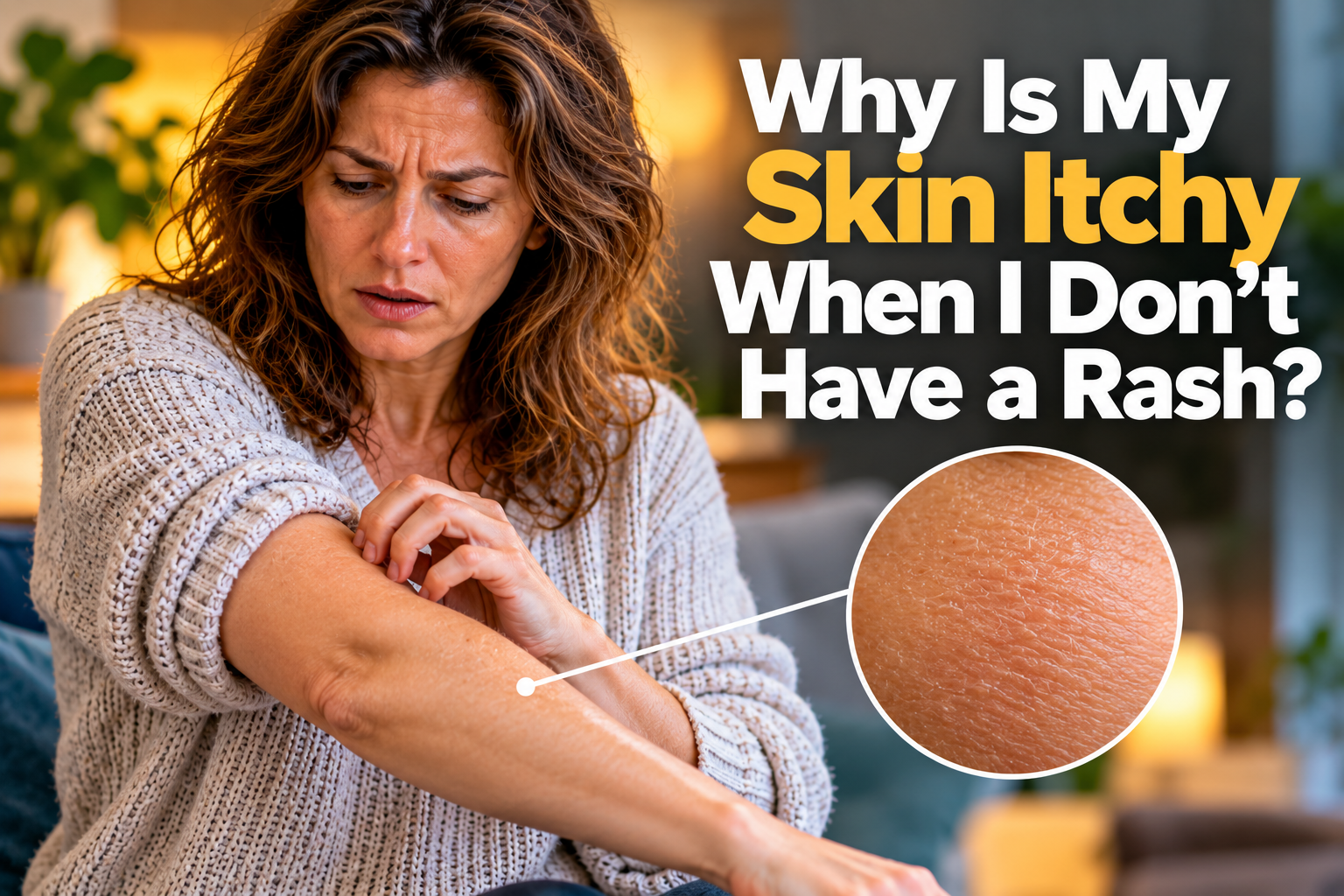
Your skin is itching.
You look at it expecting to see redness, bumps, bites or some obvious irritation.
But there’s nothing there.
It looks completely normal.
That can be particularly frustrating because when there’s no visible rash, it’s difficult to understand what’s causing the itching.
So why can your skin itch when there’s apparently nothing wrong with it?
There are actually many possible reasons, ranging from simple dry skin to medications, nerve irritation and occasionally an underlying medical condition.
The pattern of the itching often provides important clues.
You don’t need a rash to have itchy skin
The medical term for itching is pruritus.
We tend to associate itching with visible skin conditions such as eczema, insect bites or allergic reactions, but the sensation of itching is ultimately produced by signals travelling through nerves to the brain.
That means something can trigger those signals without necessarily producing a visible rash.
The first thing to notice is whether the itch is in one specific place, in several areas, all over your body, constant, worse at particular times, associated with heat, bathing or certain clothing, or accompanied by other symptoms.
Those details can dramatically narrow down the possibilities.
Dry skin is one of the most common causes
Skin doesn’t have to look cracked or flaky to be dry enough to itch.
Dry skin becomes increasingly common as we get older because the skin tends to produce less oil.
Other contributors include cold weather, low humidity, central heating, air conditioning, frequent hot showers, harsh soaps and repeated washing.
If your itching becomes worse during winter or after bathing, dryness is an obvious possibility.
Try noticing whether the skin feels tight even if it doesn’t visibly look dry.
Hot showers can make itching worse
A long hot shower may feel wonderful at the time.
But very hot water can strip oils from the skin and worsen dryness.
Some people then notice itching shortly afterwards.
If that’s your pattern, try shorter showers with warm rather than very hot water and see whether anything changes.
That simple experiment may tell you more than immediately buying several different skin products.
Could it still be eczema?
Yes.
Eczema doesn’t always begin with a dramatic visible rash.
Itching can sometimes precede obvious changes to the skin, and repeated scratching can then create redness, thickening and irritation.
We already have a detailed article covering Eczema, Dermatitis and Psoriasis and how these skin conditions differ.
If visible changes begin appearing, that becomes a more relevant possibility.
What about an allergy?
Allergies can certainly cause itching, but itching alone doesn’t automatically mean you’re allergic to something you’ve eaten.
Allergic reactions often produce additional signs such as hives, swelling, redness, wheezing, gastrointestinal symptoms or difficulty breathing.
A severe allergic reaction can develop rapidly.
If itching occurs with swelling of the lips, tongue or throat, difficulty breathing, wheezing, collapse or rapidly worsening symptoms, seek emergency medical help.
That’s very different from having mildly itchy legs every evening for several months.
New products are worth checking
Think about what touches your skin.
Have you recently changed laundry detergent, fabric conditioner, shower gel, soap, shampoo, moisturiser, deodorant, perfume, bedding or clothing?
Sometimes the culprit isn’t something you’ve eaten.
It’s something you’re repeatedly putting onto your skin or washing your clothes in.
Even products you’ve used previously can occasionally become irritating.
Clothing can trigger itching
Wool is an obvious example, but synthetic fabrics, tight clothing and friction can also irritate the skin.
Sweat trapped underneath clothing may make things worse.
Notice whether the itching disappears when you change clothes or whether it repeatedly occurs in areas where fabric rubs against the body.
Again, the pattern matters.
Could medication cause itching?
Yes.
A number of medications can cause itching, sometimes without a prominent rash.
If the problem began shortly after starting a new medication or changing the dose of an existing one, mention this to your doctor or pharmacist.
Don’t stop prescribed medication abruptly simply because you suspect it might be involved.
The timing, however, is valuable information.
Can stress make your skin itch?
Absolutely.
The nervous system and skin interact closely.
Stress doesn’t mean the itching is imaginary.
Psychological stress can alter nerve signalling, inflammatory processes and how intensely sensations are perceived.
There’s also a vicious cycle:
You feel stressed → you itch → you scratch → the skin becomes irritated → it itches more → you become more stressed.
Sometimes breaking the itch-scratch cycle itself makes a substantial difference.
Itching can sometimes come from the nerves
Not every itch begins in the skin.
Nerves can generate itching sensations too.
This is sometimes called neuropathic itch.
For example, nerve compression or damage can occasionally create a persistent itch in a particular area even though the skin looks normal.
People may describe accompanying sensations such as tingling, burning, pins and needles, numbness or crawling sensations.
If itching repeatedly occurs in exactly the same small area and is accompanied by unusual nerve sensations, that’s worth mentioning during a medical assessment.
What if the itching is all over my body?
Generalised itching deserves a little more attention, particularly when there’s no obvious skin condition.
Although dry skin remains a common explanation, widespread itching can occasionally occur with underlying medical conditions involving the liver, kidneys, thyroid or blood.
Iron deficiency is another possible contributor in some people.
That doesn’t mean widespread itching indicates serious disease.
Usually it doesn’t.
But persistent unexplained itching throughout the body is worth discussing with a healthcare professional rather than endlessly changing soaps and moisturisers.
Is itching worse at night?
Many people notice itching more when they get into bed.
There are several possible reasons.
There are fewer distractions, so bodily sensations become more noticeable.
Body temperature and skin temperature change overnight.
Dry bedding or a warm bedroom may contribute.
Certain skin conditions also become more troublesome at night.
And occasionally, severe nighttime itching can have a specific cause such as scabies, although scabies normally produces characteristic areas of irritation or small lesions eventually.
If several people in the same household suddenly become intensely itchy, particularly at night, that is useful information to tell a healthcare professional.
Could dehydration cause itchy skin?
Severe dehydration can affect the skin, but simply feeling itchy doesn’t prove you’re dehydrated.
It’s more useful to look at hydration as one part of the overall picture rather than assuming drinking several litres of water will automatically cure the symptom.
Dry skin and dehydration aren’t necessarily the same thing.
Your skin can be dry while your overall hydration is perfectly adequate.
The Natural Hygiene perspective
Natural Hygiene encourages observation before suppression.
With itching, that means asking what was happening before the symptom appeared.
Did you change a product? Have you been taking hotter showers? Has the weather become colder? Are you sweating more? Are you wearing different clothing? Did you start medication? Are you under unusual stress? Is your skin becoming visibly dry?
The body is communicating through sensation, but that doesn’t mean every itch should be interpreted as “detoxification”.
That explanation is too simplistic.
Persistent itching has many possible causes, some originating in the skin and some elsewhere in the body.
The sensible approach is to observe the pattern while remaining open to appropriate medical investigation.
Be careful with the itch-scratch cycle
Scratching provides temporary relief because it creates competing sensations in the nervous system.
Unfortunately, repeated scratching damages the skin barrier.
Then the damaged skin becomes more irritated.
Which makes it itch again.
This creates the classic itch-scratch cycle.
Keeping nails short can help reduce accidental damage.
A cool compress can sometimes calm the sensation without damaging the skin.
If dryness is contributing, reducing hot showers and harsh cleansing products may also help.
Keep a seven-day itch diary
If the cause isn’t obvious, spend a week observing rather than guessing.
Record where it itches, when it happens, whether it changes after bathing, whether warmth makes it worse, what clothing or fabrics touch the area, products used, food, medication and supplements, stress, and any visible changes.
Take a photograph if redness, bumps or another skin change appears.
After seven days, you may discover that what seemed completely random isn’t random at all.
When should unexplained itching be investigated?
Speak with a healthcare professional if the itching persists for several weeks, affects large areas of your body, is severe enough to disturb your sleep, appeared suddenly without an obvious explanation, or occurs alongside significant tiredness, weakness, unexplained weight loss, yellowing of the skin or eyes, changes in urine or bowel movements, swollen glands, unusual bruising, a new medication, or persistent numbness, burning or other nerve symptoms.
Depending on the circumstances, your doctor may simply examine your skin or may consider blood tests.
When is itching an emergency?
Itching by itself is rarely an emergency.
But seek urgent medical help if it occurs with difficulty breathing, swelling of the tongue or throat, severe wheezing, fainting or collapse, or a rapidly developing widespread allergic reaction.
Those symptoms can indicate anaphylaxis.
Don’t assume that invisible means imaginary
One of the frustrating things about unexplained itching is that other people can’t see it.
Sometimes even you can’t see anything.
But the absence of a rash doesn’t mean the sensation isn’t real.
Your skin, nerves, environment, medications and wider physiology can all influence the sensation of itching.
The useful question isn’t simply: “What cream will stop this?”
It’s: “When does this happen, where does it happen, and what repeatedly happens before it starts?”
That shift from suppressing the sensation to understanding its pattern can reveal information that would otherwise be missed.
Frequently Asked Questions
Why am I itchy but have no rash?
Dry skin is a common cause, but itching without a rash can also be associated with irritation from products or clothing, medications, nerve problems and occasionally underlying medical conditions.
Can dry skin itch without looking dry?
Yes. Skin can lose enough moisture and surface oils to become itchy without appearing obviously cracked or flaky.
Why does my skin itch more at night?
Reduced distraction, temperature changes, dry skin and certain skin conditions can all make itching more noticeable at night.
Can stress cause itching without a rash?
Stress can influence nerve signalling and increase the perception of itching. Scratching can then irritate the skin and create an itch-scratch cycle.
Can liver problems cause itchy skin?
Certain liver and bile-flow disorders can cause generalised itching, sometimes without an obvious rash. Persistent widespread unexplained itching should therefore be medically assessed rather than self-diagnosed.
Can thyroid problems cause itching?
Thyroid disorders can affect the skin and may contribute to dryness or itching in some people. Other symptoms and appropriate testing are needed to determine whether thyroid function is involved.
Should I see a doctor for itching without a rash?
If itching is persistent, widespread, severe, disrupting sleep or accompanied by other unexplained symptoms, medical assessment is sensible.