
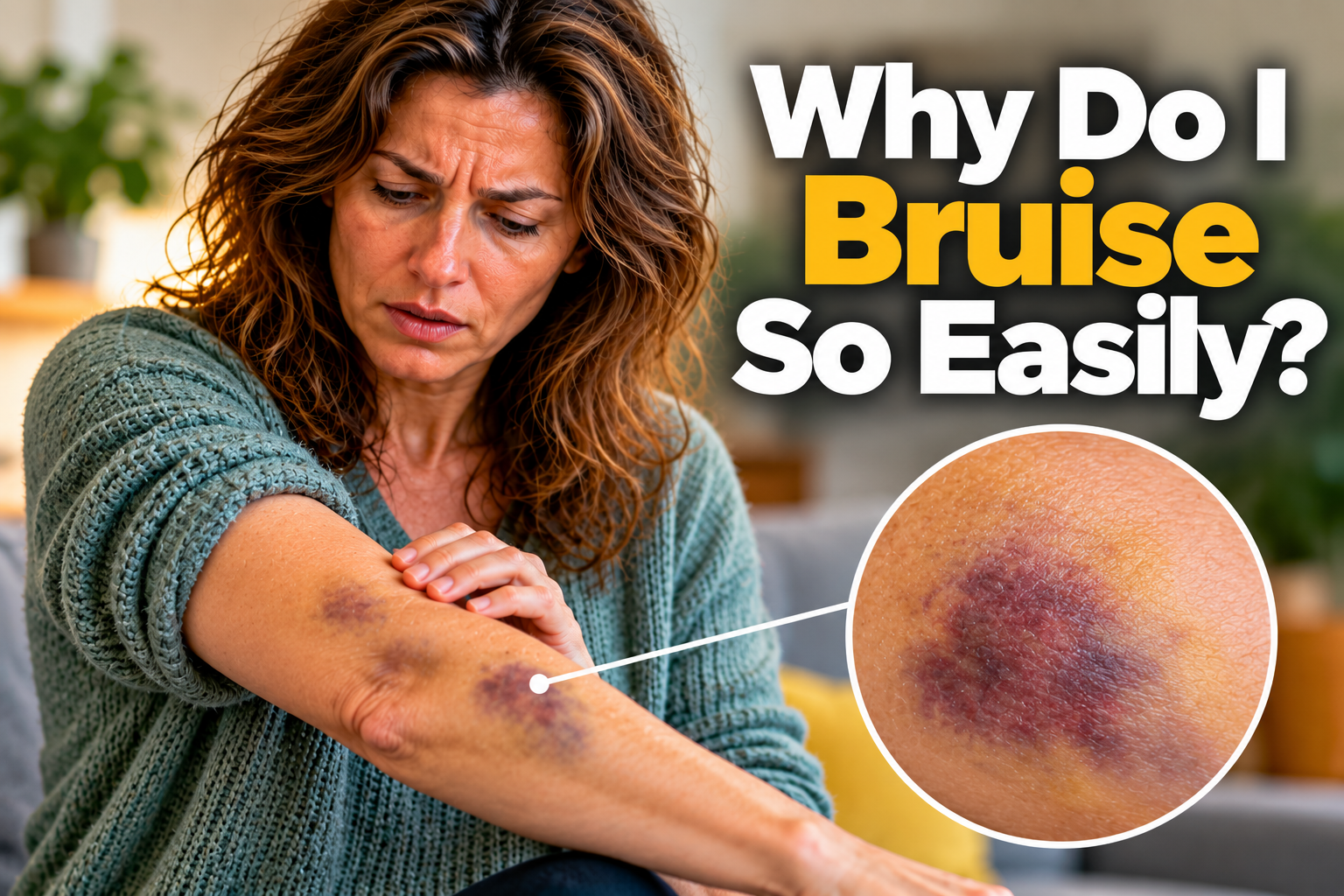
You notice another bruise on your leg.
You don’t remember banging it.
A few days later, there’s another one on your arm.
And you start wondering:
Why am I suddenly bruising so easily?
Most bruises are harmless. We often knock ourselves without remembering it, particularly on the arms and legs.
But if you’re developing bruises more frequently than you used to, they’re unusually large, or they’re appearing without any obvious reason, it’s worth understanding what’s happening.
What actually causes a bruise?
Just underneath your skin is a network of tiny blood vessels called capillaries.
When they’re damaged, a small amount of blood leaks into the surrounding tissue.
Because the skin itself hasn’t been broken, that blood becomes trapped underneath it.
That’s the coloured mark we call a bruise.
A fresh bruise may look red, purple or blue. As the body gradually breaks down and clears the trapped blood, the colour can change through shades of green, yellow and brown before disappearing.
That colour change is part of the normal resolution of a bruise.
Why don’t I remember injuring myself?
This is extremely common.
You don’t need a dramatic accident to produce a bruise.
Walking into the corner of a table, carrying something against your hip, gardening, exercise, playing sport or bumping yourself during everyday activities may be enough.
You might not even notice it at the time.
If the bruises are mostly on your shins, thighs or forearms, minor unnoticed knocks are an obvious possibility.
Bruising can become easier as you get older
Skin changes with age.
It generally becomes thinner and loses some of the fatty tissue that helps protect blood vessels underneath it.
Blood vessels can therefore become more vulnerable to relatively minor knocks.
This is one reason someone may say: “I never used to bruise like this.”
The change can be genuine without necessarily indicating disease.
Medication is an important consideration
Some medications make bruising considerably easier.
These include medicines that reduce blood clotting, such as anticoagulants and antiplatelet drugs.
Steroid medicines can also contribute to thinner, more fragile skin when used for prolonged periods.
Some antidepressants and other medications may affect bleeding or bruising in certain people.
If your bruising changed after starting a medication or changing its dose, tell your doctor or pharmacist.
Don’t stop prescribed medication on your own because you’ve noticed bruising.
The medication may be important, and suddenly stopping it could create a much greater risk.
What about aspirin?
Aspirin reduces the ability of platelets to stick together.
That’s exactly why it is prescribed to some people at risk of heart attack or stroke.
But the same effect can make bruising easier.
Again, don’t discontinue prescribed aspirin without discussing it with the clinician responsible for your care.
Can supplements contribute to bruising?
Potentially.
Some supplements can influence platelet activity or interact with medication.
This becomes particularly relevant when someone is taking several supplements alongside an anticoagulant or antiplatelet medication.
People often forget to mention supplements because they don’t regard them as medicines.
When investigating unexplained bruising, make a complete list of everything you’re taking.
Could a vitamin deficiency cause bruising?
Certain nutritional deficiencies can contribute to abnormal bruising.
Vitamin C is required for healthy connective tissue and blood vessel integrity. Severe vitamin C deficiency can therefore produce bruising and bleeding symptoms.
Vitamin K plays an important role in producing several proteins involved in blood clotting.
However, it’s important not to jump from “I’m bruising easily” to “I must be deficient in vitamin K.”
Deficiencies have causes, and taking supplements without understanding the reason can complicate matters, particularly if you’re taking anticoagulant medication.
A varied diet and appropriate investigation make more sense than guessing.
What about iron deficiency?
Iron deficiency itself isn’t usually the first explanation for isolated bruising.
However, unusual bruising occurring alongside marked tiredness, weakness, breathlessness or other symptoms may prompt a clinician to investigate your blood.
We’ve covered persistent low energy separately in our article on Chronic Fatigue: Understanding Energy, Enervation and Recovery.
Bruising plus significant fatigue deserves more attention than an occasional bruise on your shin.
Platelets matter
Platelets are tiny components of the blood involved in forming clots.
If platelet numbers become very low, or if the platelets don’t work normally, bruising and bleeding can occur more easily.
Possible signs can include frequent unexplained bruising, tiny red or purple spots on the skin, frequent nosebleeds, bleeding gums, unusually heavy menstrual bleeding or prolonged bleeding from small cuts.
A blood test can measure platelet numbers.
What are those tiny red or purple dots?
Small pinpoint spots that don’t disappear when pressed may be petechiae.
They aren’t quite the same thing as ordinary bruises.
Petechiae can have numerous causes, ranging from physical straining and medication effects to problems affecting platelets or blood clotting.
If you suddenly develop widespread unexplained petechiae, particularly if you also feel unwell, seek medical advice promptly.
Can liver problems cause bruising?
Yes, certain liver conditions can increase the tendency to bruise or bleed.
The liver produces proteins required for normal blood clotting.
Significant liver dysfunction can interfere with that process.
But bruising alone doesn’t mean you have liver disease.
Other signs might include yellowing of the skin or eyes, abdominal swelling, dark urine, pale stools or significant unexplained tiredness.
Persistent unexplained bruising alongside symptoms like these should be medically investigated.
Can alcohol make you bruise more easily?
Heavy or prolonged alcohol consumption can contribute in several ways.
It can affect the liver, nutrition and platelet function, all of which may influence bleeding and bruising.
Alcohol can also increase the likelihood of bumps and falls that you don’t fully remember.
If bruising has increased alongside substantial alcohol consumption, that’s worth mentioning honestly during a medical assessment.
What about exercise?
Exercise can occasionally produce small bruises.
Contact sports are an obvious example, but weight training, cycling, running, racquet sports and other activities can involve minor impacts or pressure.
Think about where the bruises occur.
A recurring bruise in exactly the place where equipment, handlebars, clothing or another object presses against you may have a straightforward mechanical explanation.
The location of bruises can provide clues
Bruises on exposed areas such as the shins and forearms are more likely to result from ordinary knocks.
Bruising on areas less commonly injured during daily life may deserve more attention if there is no explanation.
Similarly, one small bruise is different from suddenly discovering numerous large bruises across your body.
Look at the pattern, not just the existence of a bruise.
The Natural Hygiene perspective
From a Natural Hygiene perspective, observation comes before intervention.
Instead of immediately trying to suppress or “treat” every bruise, first understand the circumstances around it.
Ask: Have I changed medication? Am I taking supplements? Have I changed my diet substantially? Have I increased exercise? Am I playing more sport? Have I lost weight recently? Is my skin becoming thinner? Am I getting nosebleeds or bleeding gums too? Do I feel otherwise well?
A bruise is evidence that blood has escaped from small damaged vessels beneath the skin.
The body then has to break down and clear that material.
That clearing process is normal physiology.
But it would be misleading to describe unexplained bruising simply as “detoxification”.
If blood vessels are breaking easily or clotting isn’t working normally, the reason matters.
Don’t judge your health by the colour of the bruise
People sometimes become concerned when a bruise changes colour.
But changing colour is normally expected.
The pigments in the trapped blood are gradually broken down and processed.
A purple bruise becoming greenish or yellow doesn’t usually mean it’s getting worse.
Quite often, it means it’s resolving.
How long should a bruise last?
Many ordinary bruises gradually disappear over roughly two weeks, although larger bruises may take longer.
Age, location, severity of the original injury and individual differences all affect healing time.
What matters more is whether the bruise is steadily improving.
A bruise that continues enlarging, becomes extremely painful or develops significant swelling deserves more attention.
Keep a record if it keeps happening
If you’ve suddenly started bruising frequently, photograph the bruises.
Record the date they appeared, their location, approximate size, whether you remember an injury, exercise or physical activity, medication, supplements, other bleeding and other symptoms.
This gives you something objective to compare.
It’s much easier to tell a doctor: “I’ve developed 11 unexplained bruises over the last three weeks” than: “I think I’m bruising more than usual.”
When should easy bruising be checked?
Arrange a medical assessment if bruising has suddenly increased, you frequently develop large bruises without explanation, bruises appear in unusual places, or you also have frequent nosebleeds, unusually easy gum bleeding, prolonged bleeding from small cuts, unusually heavy menstrual bleeding, widespread petechiae, unusual tiredness, weakness or breathlessness, unexplained weight loss, fever, or you feel generally unwell.
Bruising that begins after starting medication or occurs with a family history of abnormal bleeding should also be discussed with a clinician.
If investigation is appropriate, blood tests can provide useful information about platelets, blood cells, clotting and sometimes liver function or nutritional status.
When is bruising urgent?
Seek urgent medical attention if you develop extensive unexplained bruising alongside significant bleeding, severe illness, confusion, severe headache, fainting, difficulty breathing or rapidly spreading pinpoint red or purple spots.
Significant bruising after a serious injury also needs appropriate assessment.
And if you’re taking anticoagulant medication, unusual bleeding or substantial unexplained bruising should be taken particularly seriously.
Most bruises are still just bruises
It’s easy to search online, see frightening explanations and assume the worst.
An occasional bruise on your leg that you don’t remember acquiring is extremely common.
The question is whether your pattern has changed.
One unexplained bruise is very different from suddenly developing numerous large bruises alongside nosebleeds and exhaustion.
Rather than focusing on one mark, look at what your body has been doing over time.
That’s where the useful information usually is.
Frequently Asked Questions
Why am I suddenly bruising easily?
Possible explanations include unnoticed minor injuries, changes in skin with age, medication, supplements and, less commonly, abnormalities affecting platelets, clotting or other aspects of health. A sudden persistent change is worth discussing with a healthcare professional.
Is it normal to bruise without remembering hitting anything?
Yes. Minor everyday knocks frequently go unnoticed, especially on the arms and legs.
Can vitamin deficiency cause easy bruising?
Severe deficiencies of nutrients involved in connective tissue or clotting, including vitamins C and K, can contribute to bruising. However, bruising alone doesn’t establish a deficiency.
Does low iron cause bruising?
Iron deficiency isn’t usually the first explanation for isolated bruising. If bruising occurs alongside substantial tiredness, weakness, breathlessness or other symptoms, medical investigation may be appropriate.
Why do older people bruise more easily?
Ageing skin becomes thinner and loses some of the tissue that protects underlying blood vessels, making minor impacts more likely to produce visible bruising.
When should I worry about unexplained bruising?
Seek medical advice when bruising suddenly becomes frequent, is unusually large or widespread, or occurs alongside abnormal bleeding, petechiae, severe fatigue or other unexplained symptoms.
Why does a bruise turn yellow or green?
The colour changes as the body breaks down components of the trapped blood. Green and yellow colouring is commonly part of the normal resolution of a bruise.