You decide to improve your diet.
You eat more fresh fruit and vegetables. You cut back on heavily processed foods, alcohol, refined sugar or other foods that have formed part of your normal routine.
You expect to feel fantastic.
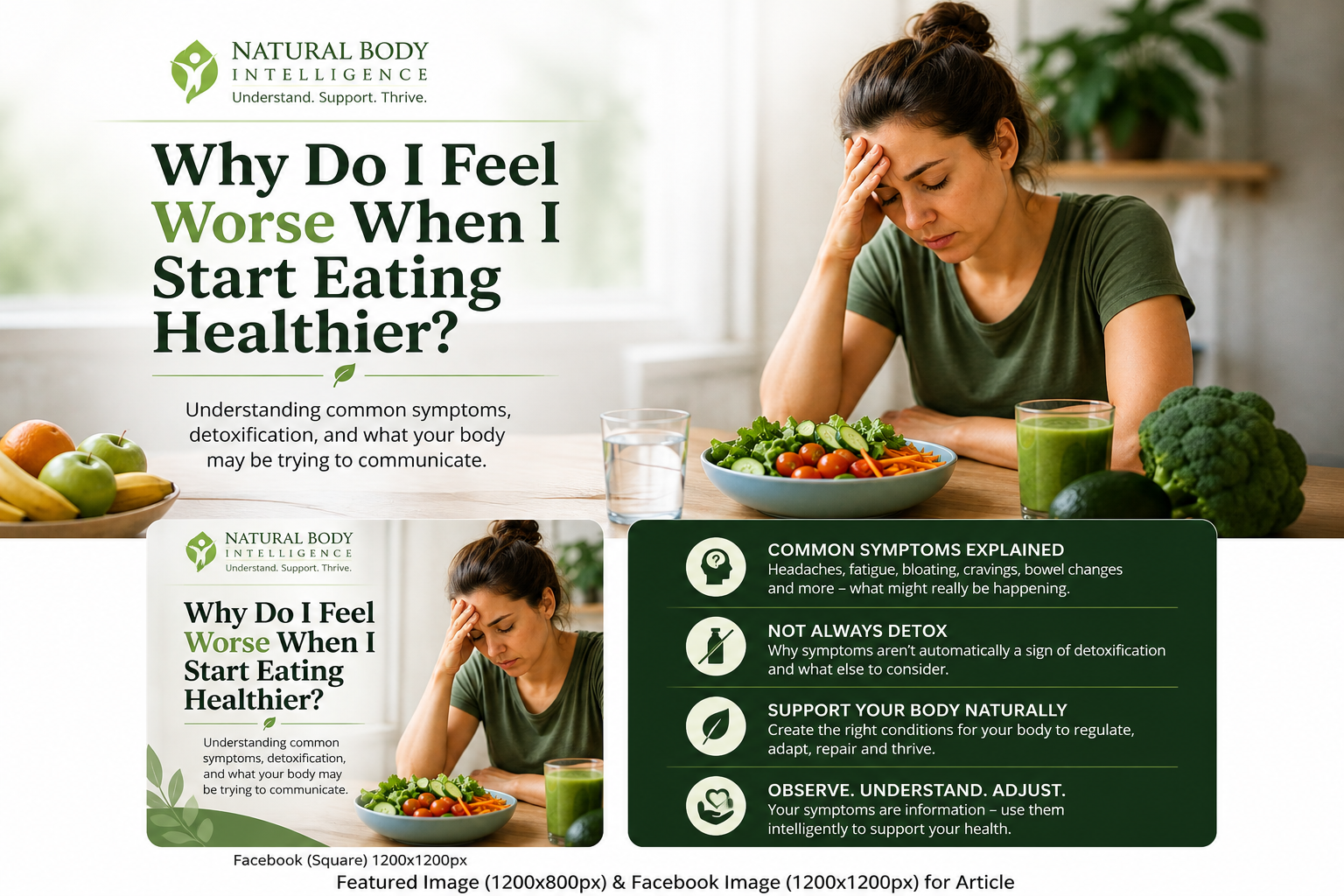
Instead, you may experience headaches, tiredness, cravings, changes in your bowel movements, bloating or simply feel worse than you did before.
It can be confusing.
If I’m eating healthier, shouldn’t I feel better?
Not necessarily straight away.
Watch: Fundamentals of Natural Hygiene Based Nutrition
This Natural Body Intelligence video explores the fundamentals of Natural Hygiene based nutrition and provides useful context for understanding what can change when somebody moves away from heavily processed foods towards simpler, more natural foods.
There are several reasons why changing your diet can temporarily change the way you feel. Some are straightforward consequences of suddenly changing what you eat, while others may reveal problems that were already present.
From a Natural Hygiene perspective, improving the conditions in which the body operates can also change its priorities. Rather than interpreting every uncomfortable symptom as something going wrong, it can be useful to look at the wider picture.
Explore Symptoms and What Your Body May Be Communicating
What Changes When You Change Your Diet?
Food affects far more than whether you feel hungry or full.
Changing what you eat can alter:
- The amount of food passing through your digestive tract
- Fibre intake
- Water intake
- Meal size and frequency
- Energy intake
- Blood glucose patterns
- Caffeine consumption
- Alcohol consumption
- Salt intake
- Bowel habits
- The composition and activity of the gut microbiome
- Your normal eating routine
If you change several of these things at once, it shouldn’t be surprising if your body feels different.
This is particularly noticeable when somebody moves very quickly from a heavily processed diet to one based predominantly on whole plant foods.
Common Symptoms After Changing Your Diet
People can experience very different things, but commonly reported symptoms after a major dietary change include:
- Headaches
- Fatigue
- Low energy
- Bloating
- Gas
- Changes in bowel movements
- Loose stools
- Constipation
- Cravings
- Irritability
- Difficulty concentrating
- Brain fog
- Changes in sleep
- Changes in appetite
- Feeling unusually hungry
- Feeling cold
- Skin changes
- Changes in mucus
- Light-headedness
The important point is that the presence of a symptom does not automatically tell us its cause.
A headache after changing your diet, for example, could coincide with reducing caffeine, eating substantially fewer calories, changes in hydration, altered meal timing or something entirely unrelated to the dietary change.
This is why context matters.
The Caffeine Effect Is Easily Mistaken for ‘Detox’
This deserves particular attention.
Imagine somebody decides overnight to become healthier.
They stop drinking coffee, energy drinks and cola. They remove processed foods and start eating fruit, vegetables and simple meals.
Within a day or two they develop a headache, tiredness, irritability and difficulty concentrating.
It would be tempting to describe everything they are experiencing as detoxification.
But if they previously consumed caffeine every day, caffeine withdrawal provides a much simpler explanation for at least some of those symptoms.
This distinction matters.
Natural Body Intelligence is not about automatically labelling every uncomfortable experience as detox.
We should always consider what has actually changed.
Eating Healthier Can Accidentally Mean Eating Too Little
This is another common problem.
A large takeaway meal, pizza, chocolate, biscuits and other concentrated foods can contain enormous amounts of energy in relatively small volumes.
Fruit and vegetables generally contain much more water and substantially fewer calories per mouthful.
Someone might therefore replace a highly concentrated 1,000-calorie meal with a large-looking bowl of fruit containing only a fraction of the energy.
Visually, they may believe they are eating plenty. Energetically, they may have dramatically reduced their intake.
If this continues, tiredness, weakness, hunger, poor concentration and reduced exercise performance shouldn’t automatically be interpreted as a cleansing reaction.
You may simply not be eating enough.
This is particularly important when making a rapid transition towards a predominantly raw or fruit-based diet.
Why Can Bloating Increase?
People are sometimes surprised when eating more fruit and vegetables initially makes them feel more bloated, not less.
One obvious reason is fibre.
If your previous diet contained relatively little fibre and you suddenly consume considerably more fruit, vegetables and salads, your digestive environment has changed substantially.
The amount, bulk and composition of material reaching the bowel changes. Your gut microorganisms are also receiving different substrates.
That can temporarily alter:
- Gas production
- Stool volume
- Bowel frequency
- Abdominal sensations
This doesn’t mean fruit and vegetables are inherently causing disease. Nor does it mean every episode of bloating should simply be ignored.
Persistent or severe bloating deserves investigation, particularly if accompanied by significant pain, vomiting, blood in the stool, unexplained weight loss or other concerning symptoms.
Your Bowel Movements May Change
Changing your diet often changes your stools.
You might notice:
- More frequent bowel movements
- Larger stools
- Softer stools
- Looser stools
- Changes in colour
- Changes in smell
- Increased gas
- Greater urgency
This is hardly surprising. Your bowel movements are partly made from the material you’ve eaten. Change that material substantially and what comes out the other end can change too.
It is therefore useful to distinguish between a change and a problem.
Not every change in bowel habits means something is wrong. But persistent diarrhoea, significant bleeding, black tarry stools, severe pain or other unusual changes shouldn’t simply be dismissed as detoxification.
What Does Natural Hygiene Mean by ‘Detoxification’?
The word detox has become enormously confused.
Online, it is often presented as something you purchase:
- A detox tea
- A detox supplement
- A cleanse
- A powder
- A seven-day programme
That isn’t what Natural Hygiene means.
The human body is continuously processing and eliminating substances through coordinated activity involving the liver, kidneys, lungs, digestive tract and other tissues.
Explore the Detoxification System
From a Natural Hygiene perspective, the aim isn’t to force detoxification with a product.
It is to reduce unnecessary burdens while providing the normal conditions required for healthy physiological function.
Those conditions include appropriate nourishment, water, sleep, rest, movement, fresh air and other fundamentals of health.
The Body Doesn’t Need to Be Forced to Clean Itself
This is an important distinction within Natural Body Intelligence.
We aren’t trying to make the body heal.
The body is already maintaining, repairing, regulating and renewing itself every second you are alive.
Cells are replaced. Damaged components are broken down. Waste products are transported. The liver processes substances. The kidneys continuously filter blood and regulate its composition. The lungs remove carbon dioxide. The digestive system processes and eliminates material. The lymphatic system continually moves fluid through its network.
The question is therefore less:
“How can I force my body to detox?”
and more:
“What conditions am I creating for my body?”
Does Feeling Worse Mean You Are Healing?
Not automatically.
This is probably the most important point in this article.
Feeling worse after making a healthy change doesn’t prove that detoxification is occurring.
Neither does it necessarily mean the healthier diet is harming you. It means something has changed and deserves to be understood.
Ask:
- What exactly did I change?
- Did I stop caffeine suddenly?
- Am I eating enough?
- Am I drinking appropriately?
- Have I dramatically increased fibre?
- Have I changed my meal frequency?
- Am I sleeping enough?
- Have I simultaneously started exercising more?
- Did the symptom already exist before the dietary change?
- Is the symptom improving, remaining the same or getting worse?
This gives you far more useful information than simply deciding: “I feel bad, therefore I must be detoxing.”
Why Symptoms Can Be Useful Information
A symptom is an experience.
It tells you that something about your current physiology deserves attention, but it doesn’t necessarily tell you why it is happening.
This is one reason we’ve created the Natural Body Intelligence Symptoms Directory.
Instead of jumping immediately from “I have symptom X” to “I must have disease Y”, you can explore:
- The symptom itself
- Other symptoms occurring alongside it
- Relevant body systems
- Recognised health conditions associated with the pattern
- Recent changes in lifestyle or diet
Explore the Symptoms Directory
Look at the Whole Body
One of the central ideas behind Natural Body Intelligence is that the body doesn’t function as a collection of isolated pieces.
Digestion interacts with circulation. The nervous system influences digestive activity. Hormonal regulation affects appetite, energy and metabolism. The lymphatic system interacts with fluid movement throughout tissues. The liver, kidneys, digestive tract and lungs all participate in maintaining the body’s internal environment.
This is why one change can sometimes be felt in several different ways.
Should You Make Dietary Changes Gradually?
For many people, gradual change is perfectly reasonable.
There is no prize for transforming your entire diet overnight.
If your current diet consists largely of processed foods, you might begin by:
- Increasing fresh fruit
- Increasing vegetables
- Simplifying meals
- Reducing heavily processed foods
- Reducing stimulants gradually
- Improving sleep
- Eating meals at more consistent times
- Paying attention to genuine hunger and satiety
You can then observe how you respond.
This has another advantage: you can actually identify which change produced which effect.
Change twenty things simultaneously and it becomes extremely difficult to know what’s responsible for anything.
Don’t Turn Healthy Eating Into Another Stress
People can become extraordinarily anxious about food.
Every ingredient becomes dangerous. Every symptom becomes detox. Every imperfect meal becomes failure. Every sensation requires analysis.
That isn’t health.
Food is only one part of the conditions in which the body lives.
Sleep matters. Movement matters. Rest matters. Sunlight matters. Fresh air matters. Human connection matters. Emotional wellbeing matters.
The aim should be to create a sustainable way of living that supports health rather than turning the pursuit of health into a permanent source of stress.
When Should You Be Concerned?
A mild temporary change after substantially altering your diet is very different from severe or persistent illness.
Seek appropriate medical assessment for symptoms such as:
- Severe abdominal pain
- Persistent vomiting
- Blood in the stool
- Black, tarry stools
- Significant unexplained weight loss
- Fainting
- Severe weakness
- Persistent diarrhoea
- Severe dehydration
- Chest pain
- Difficulty breathing
- Sudden neurological symptoms
- Symptoms that are progressively worsening
- Anything else that feels severe, unusual or concerning
Changing your diet doesn’t make every subsequent symptom a consequence of that diet.
And describing something as a healing reaction should never be used as a reason to ignore a potentially serious problem.
Frequently Asked Questions
Is it normal to feel tired after starting a healthier diet?
It can happen, but there isn’t one universal explanation. Consider whether you’ve substantially reduced calories, stopped caffeine, changed meal timing, increased activity or altered your sleep. Persistent or significant fatigue deserves further attention.
Can eating more fruit cause bloating?
A sudden increase in fruit and other plant foods can substantially change fibre intake and the material available to gut microorganisms. Some people notice temporary changes in gas or bloating. Persistent, severe or painful bloating shouldn’t simply be ignored.
Is a headache a sign of detoxification?
A headache alone cannot tell you its cause. If you’ve recently stopped or substantially reduced caffeine, caffeine withdrawal is one possibility. Hydration, food intake, sleep and numerous other factors can also contribute to headaches.
Should I stop eating healthily if I feel worse?
Not necessarily. First look at what you actually changed. A healthier diet can still be poorly planned or provide insufficient energy. Severe, persistent or worsening symptoms should be appropriately assessed rather than automatically attributed to your new diet.
How long does it take to adjust to healthier eating?
There is no single adjustment period because it depends on what you were eating before, what you’ve changed and the symptoms involved. Some changes in appetite, bowel habits or cravings may settle as a new routine becomes established, whereas persistent symptoms may have another explanation.
Is detoxification the same as a detox diet?
No. Your body already has physiological mechanisms for processing and eliminating substances. You don’t need a commercial detox product to activate them.
The Bigger Picture
Eating healthier isn’t about enduring symptoms.
It isn’t about proving how “clean” you are.
And it isn’t about treating every uncomfortable sensation as evidence that toxins are leaving your body.
It is about creating better conditions.
Better nourishment. Better rest. Better movement. Better sleep. Less unnecessary burden.
And then allowing the body to do what living organisms have always done: regulate, adapt, repair and maintain themselves.
If you’ve recently changed your diet and feel different, don’t panic — but don’t blindly label everything detox either.
Observe. Understand. Adjust.
Your symptoms are information. Use them intelligently.